
Dental advertising in Australia has to do more than attract new patients. It must provide information that is accurate, clear, evidence-based and unlikely to create unrealistic expectations about dental treatment.
This is particularly important in 2026, as dental practices increasingly use websites, Google Business Profiles, social media, paid advertising, short-form video, patient reviews, AI-generated content and SEO to reach prospective patients.
The Australian Health Practitioner Regulation Agency (Ahpra) and the Dental Board of Australia regulate advertising for registered dental practitioners under the Health Practitioner Regulation National Law. The Australian Dental Association (ADA) also provides practical guidance for dental practitioners on advertising compliance.
Ahpra’s advertising framework applies to anyone advertising a regulated health service, not just the dentist who provides the treatment. It can therefore affect dental practices, business owners, marketing teams and agencies involved in creating or publishing promotional content.
This guide explains the key AHPRA advertising guidelines for dental practices in Australia in 2026, including social media, testimonials, reviews, pricing, discounts, treatment claims, practitioner qualifications, images, SEO, Google Ads and AI-generated content.
Important: This article provides general information and is not legal advice. Advertising requirements can change and may interact with other Australian laws. Dental practices should check the current Ahpra and Dental Board guidance and obtain independent professional advice if they are uncertain about specific advertising.
What Are the AHPRA Advertising Guidelines for Dental Practices?
The advertising requirements are primarily set out under section 133 of the Health Practitioner Regulation National Law.
Under the National Law, advertising a regulated health service must not:
- Be false, misleading or deceptive, or likely to mislead or deceive.
- Offer a gift, discount or other inducement without stating the terms and conditions.
- Use testimonials or purported testimonials about the service or business.
- Create an unreasonable expectation of beneficial treatment.
- Directly or indirectly encourage the indiscriminate or unnecessary use of regulated health services.
These rules apply much more broadly than traditional advertisements.
Ahpra’s definition of advertising includes public verbal, printed and electronic communications that promote a regulated health service provider or encourage people to use a regulated health service. This can include websites, social media, directories, business cards, signage and other public-facing communications.
That means a dental practice should not assume that a blog article, Instagram Reel or Google Business Profile post is exempt simply because it is not a conventional advertisement.
The five core compliance questions
Before publishing dental marketing, ask:
- Is the information accurate?
- Can any clinical claim be supported by acceptable evidence?
- Could a patient interpret the content as promising a particular outcome?
- Does the content use a testimonial or clinical patient review?
- Could the advertising encourage unnecessary or indiscriminate treatment?
Ahpra’s self-assessment resources emphasise looking at advertising from the public’s perspective because information that appears clear to a practitioner may still be misunderstood by a patient.
Who Is Responsible for Dental Advertising?
Responsibility for dental advertising does not necessarily sit with the person who physically writes the content.
Ahpra explains that an advertiser is generally the person or organisation that controls or authorises advertising. This may include:
- A registered dentist
- A dental practice
- A practice owner
- A corporate dental group
- A marketing employee
- A marketing agency
- Another business or individual controlling the advertising
Advertisers are responsible for checking material produced by others on their behalf.
This is particularly important when a dental practice outsources:
- SEO
- Website development
- Blog writing
- Social media management
- Google Ads
- Meta advertising
- Graphic design
- Video production
- AI content creation
Hiring a marketing agency does not remove the practice’s responsibility to ensure the advertising is compliant.
For practices working with a Digital marketing agency or another Australian marketing provider, it is therefore useful to have a formal content approval process involving both marketing and appropriate clinical review.
What Are the Main AHPRA Advertising Rules for Dentists?
1. Dental Advertising Must Not Be False, Misleading or Deceptive
Accuracy is the foundation of compliant health advertising.
A dental advertisement can be problematic if it creates a false or misleading impression about:
- Treatment effectiveness
- Treatment outcomes
- Practitioner qualifications
- Specialist status
- Treatment risks
- Treatment costs
- Discounts
- Experience
- Technology
- Availability
- Suitability for patients
Examples of higher-risk wording include:
- “Guaranteed results”
- “100% success rate”
- “The best dentist in Melbourne”
- “Australia’s leading dental clinic”
- “Guaranteed perfect smile”
- “Permanent results”
- “Risk-free treatment”
- “Everyone is suitable for this treatment”
The issue is not simply whether a statement sounds promotional. The overall impression created for a reasonable member of the public matters.
Ahpra states that claims about treatment effectiveness need acceptable supporting evidence. Claims that cannot be substantiated should not be used in advertising.
Example
Higher-risk:
Get a perfect smile with guaranteed results.
More appropriate:
Explore dental treatment options that may improve the appearance and function of your teeth. Suitability and outcomes vary between patients.
The second version informs the patient without promising a particular clinical result.
2. Avoid Creating an Unreasonable Expectation of Beneficial Treatment
Advertising can breach the National Law when it creates an unreasonable expectation about the benefits of treatment.
This can occur when advertising:
- Exaggerates treatment benefits
- Promises a specific result
- Minimises risks
- Overstates recovery times
- Presents treatment as universally suitable
- Uses unrealistic imagery
- Suggests treatment is guaranteed
- Uses personal success stories to imply predictable results
- Uses emotionally charged messaging to pressure people into treatment
The basic principle is simple:
An individual patient’s outcome should not be presented as though it is the expected outcome for everyone.
This is particularly important for cosmetic and elective dental procedures.
A safer content structure explains:
- What the treatment involves
- Who may be suitable
- Factors that can affect suitability
- Potential benefits
- Relevant risks or limitations
- Why individual assessment may be required
This provides useful information without turning marketing copy into a promise.
AHPRA Social Media Guidelines for Dental Practices
Social media is covered by the advertising requirements when it is used to promote a regulated health service.
Ahpra’s social media guidance states that the National Law, professional obligations and advertising guidelines apply when registered practitioners use social media. Advertising on platforms such as Facebook or other social channels must not contain false or misleading claims or unsupported claims about treatment effectiveness.
This applies to:
- TikTok
- YouTube
- Short-form video
- Stories
- Reels
- Paid social advertising
- Practice-owned social pages
What should a dental practice check before posting?
Before publishing a social media post, ask:
- Is the information factually correct?
- Does the post make a clinical claim?
- Can the claim be supported by acceptable evidence?
- Does the wording imply a guaranteed outcome?
- Does the image create unrealistic expectations?
- Does the post contain a patient testimonial?
- Does it use a clinical review?
- Does it promote a discount without clear conditions?
- Does it make an inaccurate claim about qualifications?
- Does it encourage unnecessary treatment?
A post does not become exempt from the advertising rules simply because it is presented as a Reel, educational video or entertaining social media content.
If its purpose is to promote a dental practice or attract patients, the advertising requirements need to be considered.
What Are the AHPRA Rules for Patient Reviews and Testimonials?
Testimonials are one of the most important areas of dental advertising compliance.
Section 133 specifically prohibits the use of testimonials or purported testimonials in advertising for regulated health services.
However, there is an important distinction that is sometimes missed:
Not every positive review is automatically a prohibited testimonial.
Ahpra explains that a testimonial is a recommendation or positive statement about a clinical aspect of a regulated health service used in advertising.
Clinical aspects can include:
- Symptoms
- Diagnosis
- Treatment
- Treatment outcomes
- Skills or experience of the practitioner in a clinical context
A comment about customer service or communication that does not refer to a clinical aspect is treated differently.
Example of a clinical testimonial
“Dr Smith fixed my broken tooth and gave me an amazing smile.”
This refers to treatment and outcome.
Example of a non-clinical comment
“The reception team was friendly and the appointment process was easy.”
This does not refer to the clinical aspects of the dental service.
Even so, dental practices should review reviews carefully before using them in advertising because the surrounding content and context matter.
Can Dental Practices Use Google Reviews?
A patient can independently post a review on a third-party review platform such as Google Business Profile, Yellow Pages, BirdEye etc.
Ahpra does not require practitioners to remove testimonials from platforms they do not control simply because those comments exist. The concern arises when the advertiser uses a review or testimonial to promote the regulated health service.
Dental practices should therefore be cautious about:
- Copying reviews onto their website
- Reposting clinical reviews on Instagram
- Sharing treatment-success comments
- Creating “patient success story” posts
- Linking advertising to clinical testimonials
- Sharing or reposting clinical comments from third-party platforms
- Using patient stories as promotional content
Ahpra’s guidance also indicates that practitioners should be careful when engaging with reviews because actions such as sharing or interacting with clinical comments may contribute to the review being used in advertising.
Practical rule
If a review discusses a patient’s symptoms, diagnosis, treatment or clinical outcome, do not assume it is safe to use simply because the patient voluntarily posted it.
Can Dental Practices Offer Discounts and Promotions?
Yes, discounts and promotions are not automatically prohibited.
However, section 133 requires advertisements offering gifts, discounts or other inducements to state the applicable terms and conditions.
For example:
New patients — $99 dental check-up!
may be incomplete if important conditions apply.
Example:
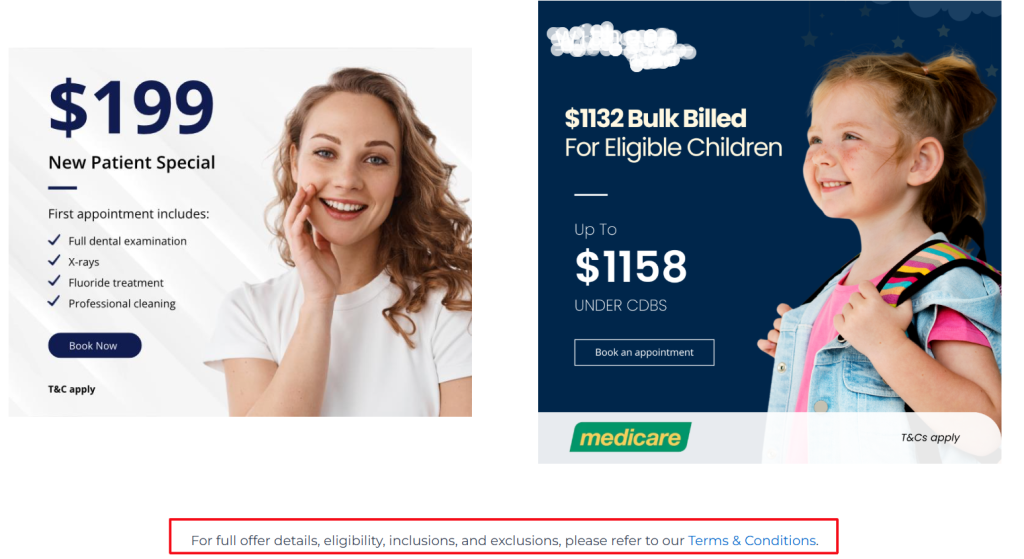
A compliant promotion should clearly explain relevant conditions, such as:
- Who can use the offer
- What is included
- What is excluded
- Whether additional fees apply
- Whether the offer applies to new patients only
- The validity period
- Whether there are appointment limitations
- Any other material conditions
Ahpra’s self-assessment tool states that terms and conditions should be easy to find and accessible rather than requiring patients to search extensively for them.
Dental Advertising and Price Claims
Price advertising can create problems when the headline price gives patients an impression that differs from the actual circumstances in which the price is available.
Examples that require careful review include:
- “From $99”
- “$500 off”
- “Free consultation”
- “No-gap dental”
- “Lowest prices”
- “Cheapest dentist”
- “Dental implants from $X”
The practice should make sure that:
- The advertised price is genuinely available.
- Important conditions are clear.
- The advertisement does not create a misleading overall impression.
- Additional costs are not concealed.
- Comparative pricing can be substantiated where relevant.
The same principle applies to website banners, Google Ads, landing pages and social media offers.
Be Careful With “Best”, “Leading” and “Number One”
Dental practices should be cautious with superiority and ranking claims.
Examples include:
- “Best dentist in Melbourne”
- “Australia’s leading dentist”
- “Number one dental clinic”
- “Best cosmetic dentist”
- “Top dental practice”
- “Leading implant dentist”
A claim may be misleading if it cannot be objectively supported or if the overall presentation gives patients an inaccurate impression.
A safer strategy is to focus on verifiable information such as:
- Practitioner qualifications
- Registration
- Experience
- Services provided
- Areas of practice
- Professional memberships
- Clinic facilities
- Appointment information
- Treatment information
This can also make the content more useful for patients and search engines than relying on unsupported superlatives.
Practitioner Qualifications and Specialist Claims
Dental advertising should accurately describe a practitioner’s:
- Registration
- Qualifications
- Professional title
- Experience
- Areas of practice
- Specialist registration
- Endorsements
Particular care is needed with terms such as:
- Specialist
- Dental specialist
- Specialises in
- Specialty
- Specialised
A practitioner should not present themselves as having specialist registration when they do not hold the relevant registration.
Example
Higher-risk:
Dr Smith | Specialist in children’s dentistry.
More factual:
Dr Smith | DEN Number () Qualifications
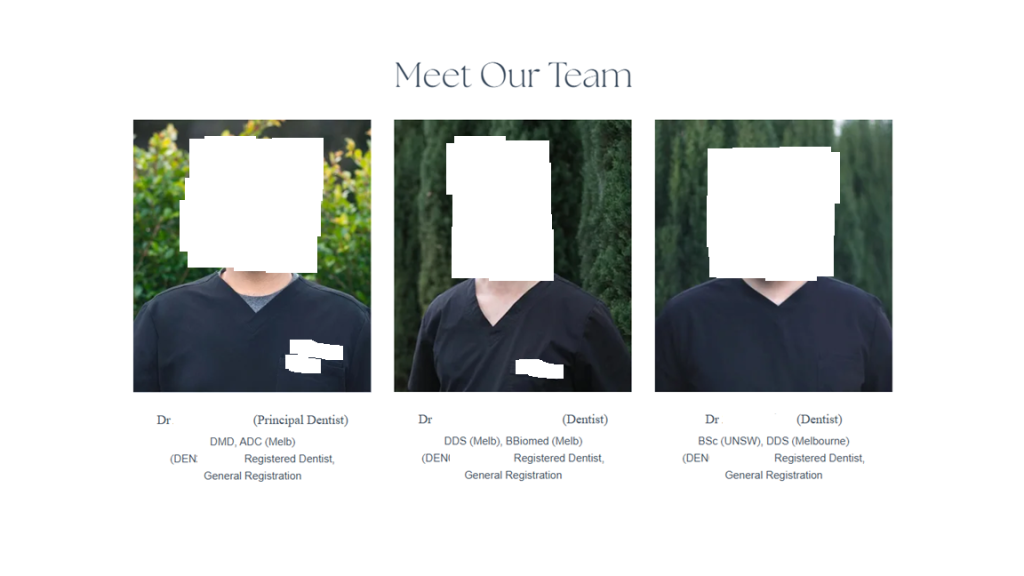
The appropriate wording depends on the practitioner’s actual registration and the context in which the claim appears.
Can Dentists Use “Dr” in Advertising?
The title “Dr” itself is not the same as a protected dental professional title, but clarity matters.
Ahpra’s advertising requirements indicate that where a person who is not a medical practitioner uses “Dr”, their profession should be made clear.
For example:
Less clear:
Dr Jane Smith
Clearer:
Dr Jane Smith, Dentist
This helps patients understand the practitioner’s profession and avoids unnecessary ambiguity.
Before-and-After Dental Photos: What Are the Rules?
Before-and-after images can be powerful marketing assets, but they also have significant potential to create unrealistic expectations.
Ahpra states that images used in advertising should not mislead consumers or create an unreasonable expectation of benefit. Images may be problematic where it is unclear that the advertised treatment caused the benefit or where images are not genuine or have been edited or enhanced.
Dental practices should therefore take care with:
- Smile transformations
- Veneer results
- Whitening images
- Orthodontic results
- Implant results
- Cosmetic dentistry photographs
Where before-and-after images are used, they should provide a fair representation of the treatment rather than an idealised marketing result.
Important considerations include:
- Use genuine images.
- Do not digitally enhance the result.
- Keep lighting and presentation as consistent as possible.
- Avoid misleading angles or framing.
- Ensure the treatment is responsible for the change being shown.
- Avoid presenting one patient’s result as though it is guaranteed for others.
Example:
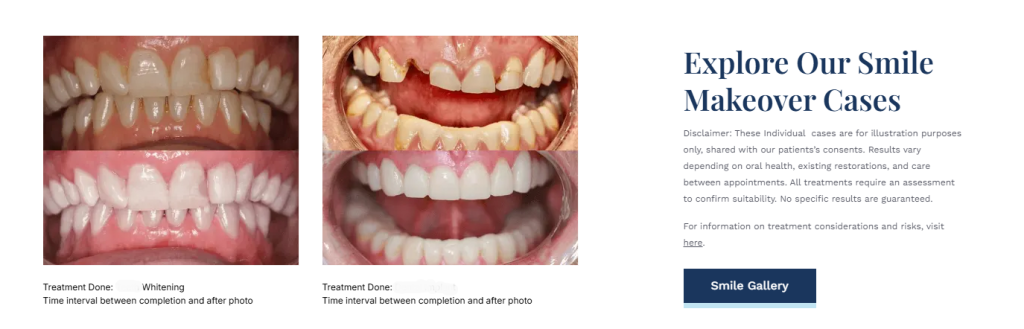
Ahpra specifically warns that before-and-after images have the potential to mislead because patients can interpret them as evidence that they are likely to achieve the same result.
For certain higher-risk cosmetic procedures, Ahpra’s newer guidance contains additional requirements around image presentation, warnings and genuine patient images. Dental practices advertising procedures that fall within those categories should check the specific guidance rather than relying only on the general advertising framework.
Avoid Urgency That Encourages Unnecessary Treatment
One area that deserves more attention in dental marketing is artificial urgency.
Ahpra identifies time-limited offers and phrases such as:
- “Don’t delay”
- “Act now”
- “Don’t miss out”
- “Time is running out”
- “Limited time only”
as potentially problematic where they create pressure to use a health service unnecessarily or imply that a person’s health may suffer without an immediate service.
This does not mean every time-limited administrative offer is automatically unlawful.
The important question is the overall message.
For example:
Higher-risk:
Don’t wait, book your dental treatment today before your teeth get worse!
This combines urgency with a potentially unsupported health consequence.
A more neutral approach would be:
Appointments are available this month. Contact the practice to discuss your dental needs and treatment options.
Dental advertising should inform patients rather than pressure them into treatment.
Avoid Encouraging Unnecessary Dental Treatment
The National Law also prohibits advertising that directly or indirectly encourages the indiscriminate or unnecessary use of regulated health services.
This can affect marketing messages that encourage people to undergo treatment regardless of clinical need.
For example, practices should be cautious with statements suggesting that everyone should receive a particular procedure without appropriate assessment.
Ahpra’s advertising guidance specifically discusses advertising that encourages people to use health services when there is no clinical or therapeutic need.
A better approach is to explain:
- When treatment may be considered
- What factors influence suitability
- Why professional assessment matters
- What alternatives may exist
- What patients should discuss with their dentist
This creates educational marketing rather than treatment pressure.
AHPRA Marketing Guidelines for Dental Websites
A dental website is advertising when it promotes the practice or attracts people to use its services.
The advertising requirements can therefore apply to:
- Homepage copy
- Treatment pages
- Service pages
- Location pages
- Practitioner profiles
- Pricing pages
- Landing pages
- Promotional banners
- FAQs
- Blog content
- Calls to action
- Images
- Videos
- Online booking pages
SEO does not override healthcare advertising requirements.
A page designed to rank for “dentist Melbourne”, “cosmetic dentist Melbourne” or “dental implants Melbourne” still needs to comply with the same advertising principles.
What does compliant dental SEO look like?
Instead of repeatedly using claims such as “best dentist”, an SEO strategy can build visibility through:
- Helpful treatment explanations
- Patient-focused FAQs
- Evidence-based information
- Accurate practitioner profiles
- Clear service descriptions
- Local information
- Treatment considerations
- Risks and limitations where appropriate
- Transparent pricing information
- Internal linking
- Technical SEO
- Structured data
- Accessible page design
For practices seeking specialist support, a Dental marketing agency can combine SEO strategy with a compliance review process rather than treating compliance as something to check after content has already been produced.
Does AI Content Have to Follow AHPRA Guidelines?
Yes, but there is an important distinction.
There is not a separate advertising exemption simply because content has been generated by artificial intelligence.
If a dental practice uses AI to create:
- Website copy
- Blog posts
- Social media captions
- Google Ads
- Meta Ads
- Video scripts
- Treatment descriptions
- SEO content
- Email marketing
The final published material still needs to comply with the applicable advertising requirements.
Ahpra also has separate guidance explaining how existing professional responsibilities apply when registered health practitioners use artificial intelligence in healthcare.
Therefore, “AHPRA AI guidelines” should not be interpreted as a separate set of rules that replaces the advertising guidelines.
A safer AI content workflow
For dental marketing, a practical workflow is:
AI drafts → human reviews → clinical claims are verified → practitioner or appropriate reviewer approves → content is published.
AI-generated content should receive additional scrutiny when it contains:
- Clinical claims
- Treatment outcomes
- Statistics
- Medical or dental terminology
- Safety claims
- Risk information
- Qualifications
- Specialist claims
- Pricing
- Comparative claims
AI can help with content production, but it should not be treated as the authority on Australian healthcare advertising compliance.
Practices considering AI SEO services should therefore ensure that AI-assisted content goes through a human quality and compliance review before publication.
Can Dental Practices Use Educational Content for SEO?
Yes.
Educational content can help patients understand dental care while also supporting organic search visibility.
Potential topics include:
- What happens during a dental check-up?
- How often should you have a dental examination?
- What should you know before dental implants?
- What factors affect suitability for orthodontic treatment?
- What happens during teeth whitening?
- How can patients maintain good oral hygiene?
- What questions should you ask before cosmetic dental treatment?
However, educational content can still become advertising when it promotes a particular dental provider or service.
The content should therefore be:
- Accurate
- Understandable
- Evidence-based
- Relevant
- Patient-focused
- Free from exaggerated claims
Avoid fear-based content designed primarily to push patients into booking treatment.
AHPRA Guidelines for Dental Google Ads
Google Ads are another form of advertising that dental practices need to review for compliance.
Paid search advertisements should be checked for:
- Unsupported claims
- Guarantees
- Superlatives
- Misleading prices
- Unclear promotional conditions
- Specialist claims
- Unrealistic outcomes
- Fear-based messaging
- Unnecessary urgency
Example
Higher-risk:
Guaranteed Pain-Free Dental Implants | Best Dentist Melbourne
More appropriate:
Dental Implants in Melbourne | Discuss Your Treatment Options
However, compliance cannot be assessed from the advertisement alone.
The landing page must also be reviewed.
A compliant Google Ad can lead to a non-compliant landing page containing exaggerated claims, testimonials, misleading prices or unrealistic treatment promises.
Therefore, dental PPC campaigns should be reviewed as a complete journey:
Ad → Landing page → Treatment information → Booking process
What Dental Practices Should Avoid in Marketing
A practical review should look for the following high-risk categories.
Unsupported guarantees
Avoid claims such as:
- Guaranteed results
- Guaranteed success
- Guaranteed smile
- Guaranteed treatment outcome
Unrealistic treatment claims
Use caution with:
- Miracle treatment
- Instant transformation
- Permanent solution
- Risk-free
- Completely safe
- Pain-free
- No recovery required
Unsupported superiority claims
Use caution with:
- Best dentist
- Number one clinic
- Australia’s leading dentist
- World’s best technology
- Superior treatment
- Cheapest dentist
Misleading specialist claims
Do not imply specialist registration or status that the practitioner does not hold.
Prohibited clinical testimonials
Do not use patient testimonials or clinical reviews as promotional advertising.
Misleading images
Do not use edited or manipulated images to exaggerate treatment outcomes.
Artificial urgency
Avoid pressure-based language that encourages patients to seek treatment unnecessarily.
The exact compliance position depends on context, so these examples are a practical risk checklist rather than a complete legal test.
Checklist Dental Practices Stay AHPRA Compliant
A formal review process makes compliance easier to manage.
Step 1: Audit all advertising channels
Review:
- Website
- Google Business Profile
- Social media
- Google Ads
- Meta Ads
- Landing pages
- Practitioner profiles
- Promotional offers
- Directory listings
- Videos
- Images
- Printed materials
Step 2: Identify clinical claims
Highlight statements relating to:
- Effectiveness
- Treatment outcomes
- Safety
- Recovery
- Pain
- Risks
- Success
- Qualifications
- Specialist status
Step 3: Check the evidence
Determine whether claims about treatment effectiveness are supported by acceptable evidence.
Ahpra’s evidence framework explains that evidence should be appropriate to the claim and warns against relying on weak or poorly controlled evidence. Certain study types, including anecdotal evidence and poorly controlled before-and-after studies, will generally not be considered acceptable support for advertising claims.
Step 4: Review testimonials and reviews
Check controlled platforms for:
- Patient stories
- Treatment reviews
- Clinical outcomes
- Success stories
- Testimonials
- Reposted patient comments
Remember that not every positive review is necessarily a prohibited testimonial; the key question is whether it concerns a clinical aspect and is being used in advertising.
Step 5: Review promotions
Check that discounts, gifts and inducements have clear, accessible terms and conditions.
Step 6: Verify practitioner information
Confirm:
- Registration
- Qualifications
- Professional title
- Specialist registration
- Endorsements
- Areas of practice
Step 7: Review images
Check:
- Authenticity
- Editing
- Lighting
- Angles
- Context
- Before-and-after presentation
- Whether the image could imply a guaranteed outcome
Step 8: Review AI-generated content
AI-generated material should receive human review, particularly where it contains clinical information or promotional claims.
Step 9: Review the patient’s perspective
Ask:
“What would a reasonable patient believe this advertisement is promising?”
This is one of the most useful final checks because Ahpra emphasises the importance of how advertising is understood by the public.
What Are the Penalties for Breaching AHPRA Advertising Rules?
Breaching section 133 of the National Law can be an offence.
Ahpra’s current advertising guidance states a maximum penalty of $5,000 for an individual and $10,000 for a body corporate under section 133.
However, dental practices should not interpret those figures as the only possible consequence of non-compliant advertising.
Advertising can also become a professional conduct matter for registered practitioners, and regulatory action may include requirements to correct advertising, restrictions or other disciplinary consequences depending on the circumstances.
The ADA similarly notes that advertising compliance is a professional responsibility and that breaches can lead to disciplinary action involving registration, in addition to potential penalties under the National Law.
The applicable legislation and penalty provisions should always be checked for the relevant state or territory and the circumstances of the matter.
How Can Dental Practices Balance AHPRA Compliance With SEO?
AHPRA compliance and SEO do not have to work against each other.
In fact, a patient-first SEO strategy can be stronger than aggressive promotional SEO.
Instead of trying to rank through repeated phrases such as “best dentist” or “number one dental clinic”, practices can build topical authority around genuinely useful information.
A compliant dental SEO strategy can include:
- Helpful treatment guides
- Evidence-based articles
- Detailed service pages
- Accurate practitioner biographies
- Patient FAQs
- Location pages with genuine local information
- Transparent pricing information
- Treatment suitability information
- Clear appointment pathways
- Internal linking
- Structured data
- Technical SEO
- Local SEO
- Accessible content
- Original research and expert commentary
The goal should be to make the website useful to both patients and search engines.
This approach is also well aligned with modern AI search, where systems increasingly need clear, direct, trustworthy information to understand and surface a business.
For example, a dental practice could create a comprehensive resource answering:
“What should I consider before choosing dental implants?”
“Cost of All on 4 Dental Implants in Perth”
rather than publishing a thin promotional page claiming that its implants are “the best”.
The first approach gives patients useful information while creating opportunities to demonstrate expertise and answer related search queries.
A Practical AHPRA Compliance Checklist for Dental Marketing
Before publishing a website page, social media post, advertisement or promotional campaign, ask:
- Is every factual statement accurate?
- Are clinical claims supported by acceptable evidence?
- Does the content avoid guarantees?
- Does it avoid unrealistic treatment expectations?
- Does it avoid prohibited clinical testimonials?
- Are patient reviews being used appropriately?
- Are images genuine and presented responsibly?
- Have before-and-after images been reviewed carefully?
- Are prices accurate?
- Are promotional terms and conditions clearly stated?
- Are practitioner qualifications accurate?
- Are specialist titles used correctly?
- Is the practitioner’s profession clear when “Dr” is used?
- Does the content avoid unnecessary treatment recommendations?
- Does it avoid inappropriate urgency?
- Has AI-generated content been reviewed?
- Does the landing page match the advertising claim?
- Would a reasonable patient understand the information correctly?
- Does the content comply with other applicable Australian legislation?
If there is uncertainty about a particular claim, image, offer or promotional strategy, it should be reviewed before publication.
Frequently Asked Questions About AHPRA Dental Advertising
Do AHPRA advertising rules apply to dental social media?
Yes. When social media is used to advertise a regulated health service, the advertising requirements under the National Law apply.
Can dentists use patient testimonials?
No. Testimonials or purported testimonials about the clinical aspects of a regulated health service cannot be used in advertising. However, not every positive comment is a testimonial; comments unrelated to clinical aspects, such as customer service, are treated differently.
Can dentists advertise discounts?
Yes, but where a discount, gift or other inducement is advertised, the applicable terms and conditions must also be stated and made accessible.
Can dentists use before-and-after photos?
They can present significant compliance risks. Images must not be misleading or create unreasonable expectations, and they should be genuine and appropriately presented. Additional requirements can apply to particular higher-risk cosmetic procedures.
Can AI write dental blog content?
AI can assist with content creation, but the final material remains subject to the applicable advertising requirements. Clinical claims, qualifications, treatment information and promotional statements should be reviewed by an appropriately qualified human before publication. Ahpra separately provides guidance on professional responsibilities when practitioners use AI.
Can dental practices use Google Reviews?
Patients can independently leave reviews on third-party platforms. The compliance issue arises when a dental advertiser uses clinical testimonials or reviews to promote its regulated health service. Practices should be particularly careful about copying, reposting, sharing or otherwise using clinical reviews in advertising.
Does AHPRA compliance stop dental practices from using SEO?
No. Dental practices can use SEO, content marketing, local SEO, Google Ads and social media. The key is that the marketing must comply with the advertising requirements while providing accurate and useful information.
Final Takeaway: What Are the AHPRA Advertising Guidelines for Dentists in 2026?
The purpose of dental advertising compliance is not to prevent practices from marketing their services.
It is to ensure that patients can make healthcare decisions based on information that is accurate, clear, evidence-based and not misleading.
For dental practices, the most important principles are:
- Do not make false or misleading claims.
- Support clinical claims with acceptable evidence.
- Do not use testimonials or clinical patient reviews as advertising.
- Do not create unreasonable expectations about treatment outcomes.
- State the terms and conditions of discounts and inducements clearly.
- Use practitioner qualifications and specialist titles accurately.
- Use images responsibly and avoid misleading before-and-after presentations.
- Do not use marketing tactics that encourage unnecessary treatment.
- Treat social media as advertising when it promotes the practice or its services.
- Review AI-generated content before publication.
- Consider the overall impression from a patient’s perspective.
- Remember that SEO does not override healthcare advertising requirements.
The strongest dental marketing strategy in 2026 is therefore not simply the one that gets the most clicks. It is one that combines search visibility, patient education, clinical accuracy and advertising compliance.
For dental practices looking to strengthen their online visibility while taking a more structured approach to healthcare advertising, a Dental marketing agency can help integrate SEO, content, website and digital marketing activity into one strategy.
A relevant example of how SEO and conversion-focused digital marketing can support dental growth is this Melbourne dental clinic SEO case study.
Ultimately, the best compliance approach is simple:
Create useful information. Make claims you can support. Be transparent about offers and limitations. Avoid promises about individual outcomes. Review every public-facing marketing asset before it goes live.
Official Australian Resources
For the most current information, dental practices should refer directly to the following authoritative resources:
- Ahpra — Guidelines for advertising a regulated health service
- Ahpra — Summary of advertising requirements
- Ahpra — Social media guidance
- Ahpra — Acceptable evidence in health advertising
- Ahpra — Advertising self-assessment tool
- Ahpra — Artificial intelligence in healthcare guidance
- Dental Board of Australia — Advertising a regulated health service
- Australian Dental Association — Advertising compliance
Last reviewed: August 2026.
Regulatory guidance can change. Dental practices should verify the current requirements with Ahpra, the Dental Board of Australia or an appropriately qualified legal or professional adviser before relying on specific advertising wording.