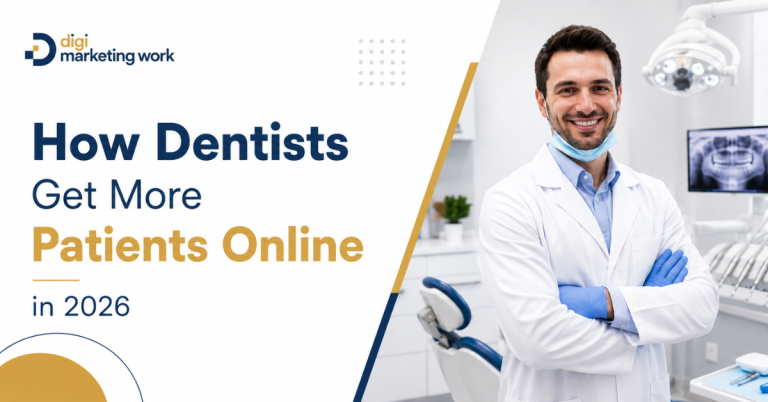
Australia’s dental industry is worth $13 billion and more competitive than ever. With over 14,800 private practices competing for patients, and nearly one in two Australians delaying or cancelling dental appointments due to cost, waiting for the phone to ring is not a strategy. 70% of Australian dental practices now rank marketing as a joint-highest business priority (CommBank/ADA Dental Insights Report 2024). Your competitors are already investing.
This guide covers the complete digital marketing stack for Australian dental practices: AHPRA compliance; local SEO across every platform that now matters; traditional SEO services; AI SEO and GEO; performance marketing through Google and Meta; and website fundamentals that turn traffic into booked appointments.
Key Takeaways
- Dental marketing in Australia must comply with AHPRA advertising guidelines.
- Local SEO now extends beyond Google to Apple Maps, Bing Places and AI search platforms.
- Educational SEO content helps practices rank in Google and AI-generated answers.
- Google Ads deliver immediate enquiries while SEO builds long-term patient acquisition.
- A fast, mobile-friendly website with online booking converts more visitors into appointments.
What is Dental Marketing?
Dental marketing is the process of attracting, converting and retaining patients using online channels such as local SEO, Google Business Profile, paid advertising, educational content, AI search optimisation and practice websites.
The State of Patient Acquisition in Australian Dentistry
Around 10,000 dentists work in group private practices and 4,900 in solo practices across Australia (AIHW 2023). 90% of clinics remain owner-operated, but corporate groups including Pacific Smiles, Bupa Dental, and 1300SMILES have expanded aggressively. A practice that would have ranked first on Google Maps five years ago with minimal effort now competes against brands running sophisticated, multi-channel campaigns year-round.
The industry benchmark is 20 to 30 new patients per month for a stable solo practice, with growth-focused clinics targeting 40 or more. In year one, a new patient is worth approximately twice the lifetime value of an existing patient. The CommBank/ADA 2024 report found that almost one in two dental patients delayed or cancelled appointments in the past year, primarily due to cost, meaning practices need to attract new patients faster than they lose existing ones. A practice that pauses marketing during slow periods does not flatline; it shrinks.
On performance marketing specifically, no single published figure covers the exact share of Australian practices running paid campaigns. CommBank/ADA data show that 33% of practices are actively investing in marketing initiatives, rising to 38% in metropolitan areas. Dental offices are increasing digital marketing investment by approximately 12% per year. Independent owner-operators are catching up, but often without AHPRA compliance oversight, which poses serious professional and financial risks.
AHPRA Compliance in Dental Marketing
Before any channel, AHPRA compliance must be understood. It is not something you add after building a campaign; it must be embedded into every piece of content, every ad, and every post. As of September 2025, the maximum penalties under the National Law are $60,000 per breach for individuals and $120,000 per breach for corporations. The practitioner is always responsible, even for content created by an external agency.
What AHPRA Prohibits
- Patient testimonials or reviews referencing clinical outcomes, treatment experience, or satisfaction with specific procedures
- Before-and-after photos for cosmetic procedures (veneers, whitening, smile makeovers) without strict conditions around authenticity, consent, and disclaimers
- Guaranteed outcome claims: “100% success rate,” “permanent results,” or anything similar
- Language targeting patient insecurities: “hate your smile?”, “fix your crooked teeth”
- Urgency-based CTAs that create undue pressure
- Influencer endorsements for cosmetic dental procedures
- AI-generated images of treatment results
What Changed in September 2025
Dental veneers now fall under AHPRA’s higher-risk cosmetic procedure guidelines. Comments and tagging on cosmetic posts may need to be disabled to prevent non-compliant testimonials from accumulating. Influencer content for any cosmetic dentistry service is banned outright. Cosmetic dentistry marketing is now treated like medical advertising rather than retail marketing.
What You Can Do
- Factual, evidence-based content about procedures and patient expectations
- Educational blog posts, FAQ pages, and procedure explainers
- Accurate qualification and award claims with full details
- Your overall Google star rating is displayed alongside a link to your review profile
- Discount promotions with clearly stated terms, conditions, and end dates
- Practice photos, team bios, and reception imagery
Local SEO in 2026: Not Just Google
Local SEO determines whether your practice appears in the Local Pack when a patient searches “dentist near me” or “emergency dentist [suburb],” the map and three listings that capture the majority of local clicks. But in 2026, Google Business Profile is no longer the only platform that matters.
- iPhone users open Apple Maps by default. It is the first-party map on every iOS device and CarPlay system in Australia. A missing or incorrect Apple Maps listing makes your practice invisible to a significant share of iPhone users, regardless of your Google rankings.
- Windows and Edge users encounter Bing search results and Microsoft Copilot, both of which draw from Bing Places. Copilot is increasingly used for local business recommendations among professional demographics.
- AI platforms, including ChatGPT, Gemini, and Perplexity, surface local business recommendations based on citation data aggregated from multiple sources. The need for AI SEO services in Melbourne is increasing daily. Strong Google presence with thin coverage elsewhere reduces your visibility in AI-generated recommendations.
What to Do on Each Platform?
- Google Business Profile: Complete every field, including services, booking link, hours, and health attributes. Select “Dentist” as your primary category. Upload at least 20 photos. Respond to every review within 48 hours. Request reviews through ethical, AHPRA-compliant means.
- Apple Maps: Claim and verify through Apple Business Connect. Match your NAP exactly to your GBP. Add photos, hours, website, and category. Takes under an hour and covers every iPhone user in your catchment area.
- Bing Places: Claim and sync with your GBP data. Feeds Microsoft Copilot and Windows 11 search. Easy to set up; almost no dental practices have done it, making it a quick competitive advantage.
- Directories: Maintain consistent NAP across Yellow Pages, True Local, HealthEngine, HotDoc, Healthshare, and the ADA member directory. Inconsistencies suppress Local Pack rankings and confuse AI recommendation systems.
Dedicated suburb and service pages targeting terms like “emergency dentist [suburb]” and “children’s dentist [city]” capture high-intent patients who have already decided they need a dentist and are now choosing who to call.
What is Local SEO for Dentists?
Local SEO helps dental practices appear when patients search for services like “dentist near me” or “emergency dentist in Melbourne.” It includes Google Business Profile optimisation, citation management, local landing pages and online reviews.
Dental SEO as a Long-Term Asset
Unlike Google Ads, which stops generating leads the moment the budget is paused, a well-ranking dental website attracts new patient enquiries 24 hours a day without additional cost per click. Practices that invested in SEO during 2020 to 2022 now dominate local search in most Australian metro areas at near-zero marginal cost. Delayed practices are paying significantly more in Google Ads to achieve the same visibility.
Most dental practices see measurable improvements in rankings within 3 to 6 months for suburban and service-specific keywords. Competitive metro markets may take 9 to 18 months. Treat SEO as a minimum 12-month investment.
Effective dental SEO needs three layers in place:
- Technical: Fast mobile loading, HTTPS, correct indexing, and LocalBusiness/Dentist schema markup
- On-page: Individual service pages for every treatment, location pages for your catchment suburbs, and FAQ content written in the language patients search, not clinical terminology
- Off-page: Backlinks from the ADA directory, HealthEngine, HotDoc, local health directories, and relevant local press
The most effective and fully AHPRA-compliant content strategy is patient education: “what to expect during a root canal,” “how long do dental implants last,” “when to see an emergency dentist.” This content ranks well, pulls patients in at the research stage, and requires no testimonials, before-and-after images, or outcome claims. According to BrightLocal, practices in the top 3 positions of the Local Pack receive 70% of all local clicks; the first organic result captures approximately 33%.
AI SEO and GEO for Dental Practices
AI SEO and GEO, also called Generative Engine Optimisation (GEO), optimises your presence so it appears in AI-generated recommendations across Google AI Overviews, ChatGPT, Gemini, Perplexity, and Microsoft Copilot. Around 12% of Australian dental practices currently use AI tools internally, but only a fraction are optimising AI as a patient discovery channel, where the competitive gap remains wide open (BDO Australia, 2025).
When a patient asks Gemini, “Who is a good dentist in [suburb]?” the recommended practices share these characteristics:
- Complete, verified profiles across Google, Apple Maps, and Bing
- Consistent NAP on all platforms and directories
- Genuine review volume with active owner responses
- Authoritative educational content answering specific patient questions
- LocalBusiness and Dentist schema on every relevant page
- Multiple detailed pages on the same service, demonstrating topical depth
Google AI Overviews now appear for a growing share of dental queries, particularly informational ones. Dental practices whose educational content gets cited receive referral traffic and brand visibility without paying per click. Short, generic service descriptions are rarely cited. Detailed pages that directly answer specific patient questions are.
GEO Checklist for Dental Practices
✓ Google Business Profile completed
✓ Apple Maps verified
✓ Bing Places verified
✓ Consistent NAP across directories
✓ Dentist Schema implemented
✓ FAQ pages
✓ Educational blog content
✓ Review responses
✓ Local landing pages
✓ Fast mobile website
Performance Marketing: Google Ads and Meta
Performance marketing delivers immediate results. A well-configured Google Ads campaign can generate new patient bookings within the first week. This makes it valuable for new practices, practices launching a new service, or practices recovering ground after a quiet period. The AHPRA risk, however, is highest here and must be actively managed.
Google Ads
Google Ads captures patients at the bottom of the funnel, those already searching for a dentist right now. High-performing dental campaigns target urgent, location-specific terms: “emergency dentist [suburb],” “dentist open Saturday [city],” “dental implants near me.” Call-only ads connect searchers directly to your front desk. Location extensions show your address and click-to-call within the ad itself.
Every headline, description, and landing page must be AHPRA-compliant: factual, no outcome guarantees, no patient quotes. Negative keywords excluding “dental school,” “dental supply,” and “dental jobs” prevent wasted spend.
Meta Ads
Meta reaches patients who are not yet searching but match your target patient’s demographic profile. It works for awareness and remarketing. The AHPRA risk is highest on Meta: before-and-after photos, testimonials in ad copy, influencer posts, and outcome-based claims are all prohibited and all common on dental social accounts. Specific steps for Meta compliance:
- Disable comments on boosted cosmetic procedure posts to prevent testimonials from accumulating
- Review all existing creatives against the September 2025 AHPRA guidelines before running
- Avoid emojis AHPRA has flagged as trivialising procedures
| Factors | Google Ads / Meta | SEO |
| Time to results | Days to weeks | 3 to 18 months |
| Cost | Ongoing cost per click | Compounding returns |
| What happens when you stop | Leads stop immediately | Rankings persist |
| Best use | New bookings, new services | Sustainable patient flow |
Most practices benefit from running both. A practice relying entirely on paid channels is one budget decision away from losing all digital patient acquisition overnight. Most successful practices allocate 4 to 7% of gross revenue to marketing, with digital channels taking approximately 80% of that budget.
Website and Conversion Fundamentals
All the traffic in the world does not matter if your website does not convert visitors into booked appointments. The website is where every channel sends potential patients before they decide whether to call. DigiMarketing supports dental marketing by providing website development in Melbourne.
A high-converting dental website needs:
- Mobile-first design with fast loading: most local dental searches happen on a smartphone
- Click-to-call and online booking above the fold, visible immediately on every device
- Trust signals: practice photos, team bios, qualifications, and ADA membership
- Individual service pages for every treatment, structured with clear headings and AHPRA-compliant content
- FAQ section answering the questions patients ask before booking: costs, insurance, what happens at a first appointment
- Location and parking information so new patients know they can get to you
On reviews: displaying your aggregate Google star rating and linking to your review profile is permitted. Featuring individual patient reviews mentioning clinical outcomes or treatment satisfaction in your marketing materials is not. Only 26% of dental practices currently offer online booking, making it a genuine competitive advantage for those that implement it via HotDoc or HealthEngine.
Common Dental Marketing Mistakes
- Ignoring Apple Maps
- Having inconsistent business information
- Running non-compliant Meta ads
- Publishing thin service pages
- Not responding to reviews
- Slow mobile websites
- No structured data
- No online booking
Dental Marketing in 2026 at a Glance
Successful Australian dental practices combine:
- AHPRA-compliant marketing
- Local SEO
- Google Business Profile optimisation
- Apple Maps
- Bing Places
- Educational SEO content
- GEO optimisation
- Google Ads
- Meta Ads
- High-converting websites
- Online booking
- Review management
Frequently Asked Questions
How do dentists get new patients online?
Through local SEO across Google, Apple Maps, and Bing; AHPRA-compliant Google Ads; an educational content strategy that ranks in organic and AI search; and a website with online booking. Each channel serves a different part of the patient acquisition funnel. Additionally, social media marketing helps to increase online reach.
How many new patients per month does a practice need?
20 to 30 per month sustains a stable solo practice; 40 or more supports a growth-phase clinic. The right target depends on your current attrition rate and chair capacity.
Can dentists use Google Ads in Australia?
Yes, but all copy must be AHPRA-compliant: no testimonials, no guaranteed outcomes, no before-and-after claims. Non-compliant Google Ads carry the same penalties as any other regulated health advertising, up to $60,000 per breach.
Can a dental practice show Google reviews on its website?
The overall star rating and a link to the Google review profile are permitted. Featuring individual reviews that mention clinical outcomes or treatment experiences in marketing materials is restricted under AHPRA guidelines.
Is SEO or Google Ads better for dentists?
Both serve different functions. Google Ads delivers immediate bookings but stops when the budget pauses. SEO compounds over time and generates enquiries without ongoing cost per click. Most practices should run both simultaneously.
What is the AHPRA risk for dental marketing?
Penalties are up to $60,000 per breach for individuals and $120,000 for corporations under the September 2025 guidelines. The practitioner is always responsible for published content, including content created by a third-party agency.
Do Apple Maps and Bing Places matter?
Yes. Apple Maps is the default map on all iPhones. Bing Places feeds Microsoft Copilot and Windows 11 search. Practices not listed on these platforms are invisible to patients who never start their search on Google.
How long does dental SEO take?
Most dental practices see SEO improvements within 3–6 months for local keywords, while highly competitive areas may take 9–12 months. Consistent optimisation delivers the best long-term results.
Why do dentists need Apple Maps?
Apple Maps helps dentists reach iPhone and Apple CarPlay users. A verified Apple Business Connect profile improves local visibility and ensures patients can easily find accurate practice information.
How do AI Overviews choose dentists?
AI Overviews recommend dentists based on trusted content, local relevance, accurate business listings, positive reviews, structured data, and website authority. High-quality educational content also increases visibility.
How often should Google Business Profile be updated?
Update your Google Business Profile at least monthly and whenever your hours, services or contact details change. Regular posts, new photos and review responses help improve local search visibility.
Conclusion
Getting new dental patients online in 2026 requires a coordinated system: local SEO across Google, Apple Maps, and Bing; long-term organic authority through AHPRA-compliant educational content; AI search visibility through GEO fundamentals; performance marketing for immediate bookings; and a website designed to convert. AHPRA compliance is not a constraint on this system; it is the foundation that makes it trustworthy and sustainable.
Digi Marketing Work helps Australian dental practices build compliant digital marketing systems that generate consistent new patient bookings. Not sure where your digital presence is losing patients? Get your free dental marketing audit today.