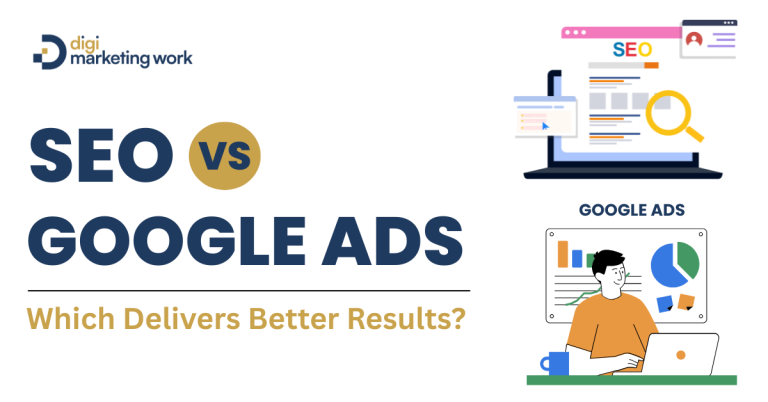
Every Australian small business owner with a website eventually faces the same question: should you invest in SEO, Google Ads, or both? Both channels drive traffic, generate leads, and grow revenue, but they work in fundamentally different ways, on different timeframes, and at different costs.
This comprehensive guide breaks down the real difference between SEO and Google Ads for small businesses covering:
- Cost
- ROI
- Trust
Targeting, and the smartest strategic approach for each stage of business growth. Whether you are a local plumber in Melbourne, a dental clinic in Brisbane, or an e-commerce store serving customers nationally, understanding how these two channels compare will help you allocate your marketing budget with confidence.
SEO vs Google Ads for Small Businesses
- SEO builds long-term growth, while Google Ads delivers immediate results.
- Google Ads works instantly, but traffic stops when you stop spending.
- SEO takes 3–12 months to gain traction but can generate ongoing leads for years.
- SEO often provides better long-term ROI, while Google Ads is ideal for short-term campaigns.
- Google Ads offers precise targeting by location, keyword, audience, and device.
- Organic search results generally earn more trust from users than paid ads.
- Google Ads data can improve SEO by identifying high-converting keywords and messaging.
- AI-powered search is changing SEO, making high-quality, structured content more important than ever.
- The best strategy for most small businesses is to combine SEO and Google Ads; use ads for immediate leads while SEO builds sustainable, long-term growth.
What Is SEO?
Search Engine Optimisation (SEO) is the practice of improving your website so that it appears higher in Google’s organic (unpaid) search results. When someone searches for “emergency plumber Sydney” or “best accounting firm Melbourne,” the businesses that rank on the first page have typically invested in SEO over time.
SEO is not a single tactic but a combination of three interconnected disciplines:
- On-page SEO: Covers the content, structure, and keywords on each page of your website. This includes title tags, meta descriptions, heading hierarchy, internal linking, and the quality and relevance of your written content.
- Off-page SEO: Covers your website’s authority in the eyes of Google, primarily built through backlinks from other reputable websites. The more quality websites that link to yours, the more trustworthy Google considers you to be.
- Technical SEO: Covers the infrastructure of your website: page speed, mobile-friendliness, crawlability, schema markup, Core Web Vitals, and everything else that affects how Google’s algorithms can read and index your site.
SEO takes time to build momentum, but once it does, it generates compounding, long-term traffic that continues even after you stop paying. The median ROI from SEO is 748%, returning $7.48 for every $1 invested, and organic search drives 53% of all trackable website traffic.
What Are Google Ads?
Google Ads (formerly known as Google AdWords) is Google’s pay-per-click (PPC) advertising platform. It allows businesses to place paid advertisements at the top and bottom of Google’s search results pages, in the Shopping tab, across Google’s Display Network, and on YouTube.
When someone searches a keyword you are bidding on, your ad may appear above the organic results with a small “Sponsored” label. You pay Google each time someone clicks your ad. The amount you pay per click depends on how competitive the keyword is, your Quality Score, and how much competing advertisers are bidding.
There are several Google Ads formats relevant to small businesses:
- Search Campaigns: Show text ads in response to specific keywords, making them ideal for capturing high-intent searches.
- Display Campaigns: Show image or banner ads across millions of websites in Google’s network, useful for brand awareness.
- Shopping Campaigns: Display product images and prices directly in search results, essential for e-commerce businesses.
- Local Campaigns: Are designed to drive foot traffic to physical locations, using location signals to target nearby searchers.
The key distinction from Google SEO vs Google Ads is that SEO earns its position organically over time, while Google Ads buys immediate placement at the top of the page. Google Ads vs AdWords is simply a naming distinction: Google rebranded its advertising platform from Google AdWords to Google Ads in 2018, though the underlying PPC model remains the same.
SEO vs Google Ads: Key Differences at a Glance
| Factor | SEO | Google Ads |
| Cost structure | Ongoing investment in content and optimisation | Pay per click |
| Time to results | 3 Months to years | Immediate |
| Traffic source | Organic | Paid |
| Long-term value | High: continues after investment pauses | Stops when the budget ends |
| Trust level | Higher: users trust organic results more | Moderate: users recognise paid labels |
| Scalability | Gradual and compounding | Rapid and controllable |
| Click-through rate | Often higher for informational searches | Depends on ad quality and competition |
| Keyword testing | Slow feedback loop | Immediate data on what converts |
SEO vs Google Ads: Pros and Cons
Advantages of SEO
- Sustainable traffic: Once your pages rank, they continue attracting visitors without an ongoing per-click cost. A well-ranked page can generate leads for years from a one-time investment in content.
- Higher credibility and trust: Research consistently shows that users click organic results more than paid ads for most search queries, particularly informational and research-stage searches. Being on page one organically signals to users that Google has validated your authority.
- Better long-term ROI: The cost per lead from SEO typically falls over time as your site builds authority. Early costs are higher, but as more pages rank and traffic compounds, the acquisition cost per customer drops significantly.
- Increased brand authority: Consistently ranking for relevant keywords builds brand recognition and positions your business as a trusted industry resource.
Disadvantages of SEO
- Slower results: It typically takes three to six months before meaningful results appear, and twelve months or more to achieve competitive rankings for high-difficulty keywords. Businesses that need immediate leads cannot rely on SEO alone.
- Ongoing optimisation required: SEO is not a set-and-forget exercise. Content needs to be updated, new pages created, and technical issues addressed on an ongoing basis to maintain and improve rankings.
- Vulnerability to algorithm updates: Google updates its algorithms hundreds of times each year. Major updates can significantly shift rankings, requiring businesses to adapt their strategies in response.
Advantages of Google Ads
- Immediate visibility: Ads can appear at the top of Google’s search results the same day a campaign goes live, making Google Ads the fastest way to reach qualified searchers.
- Precise targeting: Google Ads allows targeting by keyword, location, device, time of day, audience demographics, and previous website visitors. This precision makes it highly effective for reaching the right people at the right moment.
- Measurable performance: Every click, conversion, and dollar spent is tracked in real time. This makes it straightforward to calculate cost per lead, cost per acquisition, and return on ad spend (ROAS).
- Scalable campaigns: The budget can be adjusted at any time. If a campaign is delivering strong results, you can scale spend rapidly. If it is underperforming, you can pause or restructure it immediately.
Disadvantages of Google Ads
- Rising CPC costs: The average cost per click on Google Ads in Australia generally ranges from $2 to $4 AUD on the Search Network. Industries like legal, insurance, and finance often face CPCs of $10 or more, while e-commerce and local services typically pay much less. In highly competitive industries, Google Ads can become expensive quickly.
- Traffic stops when spending stops: Unlike SEO, there is no residual benefit from Google Ads once the budget is exhausted. The moment you pause a campaign, your paid visibility disappears.
- Competitive bidding environment: Larger competitors with bigger budgets can outbid you for the same keywords, making it harder for small businesses to compete on cost-per-click alone without a well-optimised campaign structure.
SEO vs Google Ads Cost: Which Is More Affordable?
The major difference between SEO and Google Ads lies not in the upfront spend but in the long-term economics. SEO has higher upfront costs relative to immediate returns but becomes progressively more cost-efficient as rankings build. Google Ads has a predictable cost per click but no accumulated value over time.
How Much Does SEO Cost in Australia?
SEO in Australia costs $1,000 to $5,000 per month for most small and mid-sized businesses in 2026, based on published pricing from multiple Australian agencies.
The typical investment tiers look like this:
- Under $1,500 per month: Entry-level SEO covering basic on-page optimisation, limited content production, and foundational technical fixes. Suited to businesses in low-competition local markets.
- $1,500 to $3,500 per month: Growth-tier SEO with regular content creation, link-building activity, and more comprehensive technical optimisation. Suitable for most small businesses in moderately competitive industries.
- $3,500 to $7,500+ per month: Competitive-tier SEO targeting high-difficulty keywords in saturated markets. Involves extensive content, aggressive link acquisition, and specialist technical work.
Hourly SEO consulting in Australia typically runs from $150 to $300 per hour. Project-based SEO engagements for one-off technical audits or website migrations can range from $1,500 to $10,000, depending on complexity.
How Much Does Google Ads Cost in Australia?
Google Ads costs for Australian small businesses typically fall into two categories: management fees and media spend.
Management fees for a Google Ads agency in Australia range from $500 to $2,000 per month, depending on campaign complexity. Media spend (the amount paid directly to Google) varies widely, but many small businesses start with $1,000 to $3,000 per month.
Total monthly investment for a managed Google Ads campaign in Australia, including agency fees and media spend, typically ranges from $1,500 to $5,000 for a small business. The key metric to watch is cost per acquisition (CPA): the total spend divided by the number of leads or sales generated. In high-CPC industries like legal or finance, a single lead can cost $100 to $400 or more. In local services, it can range from $15 to $50.
- The compounding advantage of SEO over time: A business spending $2,000 per month on SEO for two years builds a permanent traffic asset. The same $48,000 spent on Google Ads generates traffic only while the spend is active. Over a three to five-year horizon, a well-executed SEO strategy almost always produces a lower cost per acquisition than Google Ads alone.
SEO vs Google Ads for Small Businesses
When SEO Makes More Sense?
SEO is the stronger choice for businesses with a medium to long-term outlook. Local service providers, including plumbers, electricians, dental clinics, and accounting firms, are particularly well-suited to local SEO because once rankings are established, the effective cost per lead becomes very low. For any business willing to invest consistently over 12 or more months, the compounding returns from organic search mean the investment continues to pay dividends well into the future.
It also makes sense for businesses with limited advertising budgets that cannot sustain ongoing pay-per-click costs indefinitely. Building organic authority creates a permanent traffic asset rather than a recurring expense.
When Is Google Ads the Better Choice?
Google Ads is the right primary channel when speed matters. New businesses that cannot wait six to twelve months for SEO to deliver results, businesses launching new products or services, and companies running seasonal promotions all benefit from the immediate visibility Google Ads provides. You can appear at the top of search results on day one, making it essential for anyone who needs leads now, not later.
It also suits competitive markets such as e-commerce, real estate, and finance, where building organic rankings takes years. Google Ads lets you compete immediately while your SEO strategy develops in the background.
SEO vs Google Ads ROI: Which Generates Better Returns?
Google Ads consistently wins on short-term ROI. A well-managed campaign can generate a positive return within weeks, making it highly effective for businesses where cash flow is the priority. The trade-off is that this return evaporates the moment spending stops.
SEO delivers superior long-term ROI for most business types. Organic traffic compounds as more pages rank and as the domain authority builds. A page that ranks well today may continue generating leads for three to five years with only periodic maintenance.
Measuring SEO ROI
Tracking SEO ROI requires monitoring organic traffic growth over time, the volume of leads or sales generated from organic search, the reduction in cost per acquisition as traffic grows, and the brand authority benefits that come from consistent first-page visibility. Tools like Google Analytics 4, Google Search Console, and SEO platforms such as Semrush or Ahrefs make this measurable.
Measuring Google Ads ROI
Google Ads ROI is more immediately transparent. Google Ads provides real-time data on impressions, clicks, conversions, and cost per conversion. Smart bidding strategies can automatically optimise toward your cost-per-acquisition target. This data is also invaluable for understanding which keywords and messages convert best, intelligence that can be fed directly back into your SEO strategy.
Google Ads vs Organic Search: What Do Customers Prefer?
User Trust and Click Behaviour
Studies consistently show that organic results receive the majority of clicks on Google’s search results page. Many users actively skip or scroll past paid ads, particularly for research-stage and informational searches. The “Sponsored” label, while subtle, does signal to savvy users that the result is a paid placement rather than an independently earned position.
That said, the gap between organic and paid click-through rates narrows significantly for high-intent commercial searches, particularly on mobile devices where paid ads dominate the visible screen area.
Search Intent Matters
Informational searches (“how to fix a leaking tap”) strongly favour SEO because users are seeking content and expertise, not an advertisement. These searches are better served by educational blog posts, guides, and FAQs that rank organically.
High-intent commercial searches (“plumber Hobart emergency”) often convert well through Google Ads because the user has already decided to hire someone; they are simply choosing who. In these cases, being at the very top of the results, whether paid or organic, is a significant advantage.
Mobile Search Trends in Australia
Australia has one of the highest smartphone penetration rates globally. Mobile searches now account for the majority of Google searches in Australia, and on mobile, paid ads occupy even more of the above-the-fold screen real estate than on desktop. For businesses targeting local intent searches on mobile devices, Google Ads can be particularly powerful because ads appear at the very top of the screen before any organic results are visible.
Why the Best Strategy Often Combines Both?
Many of Australia’s most successful small businesses run SEO and Google Ads simultaneously. This hybrid approach is more effective than either channel alone for several reasons.
- Using Google Ads while SEO builds traction: This solves the fundamental problem of SEO’s slow start. Run Google Ads to generate leads in months one to six while your SEO strategy develops. As organic rankings improve, gradually reduce PPC spend.
- Keyword testing through PPC: Keyword testing gives SEO teams invaluable data. Running ads on a range of keywords shows which ones actually convert, not just which ones generate traffic. The best-performing keywords from your ad campaigns become priority targets for your organic content strategy.
- SERP domination: It occurs when your business appears in both a paid ad and an organic result on the same search page. Appearing twice signals authority, pushes competitors further down the page, and increases the probability that a searcher clicks your result.
- Remarketing opportunities: This allows you to use Google Ads to re-engage visitors who found you through organic search but did not convert. This is a powerful way to extract more value from the traffic your SEO investment generates.
How AI Search Is Changing the SEO vs Google Ads Equation?
The rise of AI-powered search, including Google’s AI Overviews, ChatGPT search, and Perplexity, is reshaping how both SEO and Google Ads perform. Traditional SEO and PPC strategies were built around a results page of ten blue links and a handful of ads. That landscape is shifting toward AI-generated answers, summarised directly on the search page or inside a conversational AI tool, often without the user ever clicking through to a website.
For small businesses, this means visibility now depends not just on ranking or bidding, but on whether your content is structured in a way AI systems can understand, extract, and cite. This has given rise to three closely related disciplines: AI SEO, Generative Engine Optimisation (GEO), and Answer Engine Optimisation (AEO).
What Is AI SEO?
AI SEO refers to optimising your website and content specifically for visibility within AI-powered search features, including Google’s AI Overviews and AI Mode. It builds on traditional SEO fundamentals, technical health, quality content, and authority, but places additional emphasis on clear, well-structured information that AI models can easily parse and summarise. Businesses that already have strong organic SEO foundations are generally better positioned to appear in AI-generated answers.
What Is Generative Engine Optimisation (GEO)?
GEO is the practice of optimising content so that it gets cited and referenced by generative AI tools such as ChatGPT, Google Gemini, and Perplexity when users ask questions related to your industry. Unlike traditional SEO, which targets a ranking position, GEO targets inclusion in an AI-generated response. This typically rewards content that is factual, well-sourced, clearly structured with headings and lists, and written to directly answer specific questions rather than relying on keyword density alone.
What Is Answer Engine Optimisation (AEO)?
AEO focuses on optimising content to directly answer specific user questions in a concise, extractable format, the kind of content that gets pulled into featured snippets, voice search results, and AI Overviews. Practically, this means structuring content with clear questions as headings, providing direct answers in the first one to two sentences, and using FAQ sections, exactly like this one, that mirror how people actually phrase their queries.
Why This Matters for the SEO vs Google Ads Decision?
AI search adds a new layer to the SEO vs Google Ads comparison. Google Ads remains largely unaffected in mechanics, since paid placements still appear distinctly within AI-enhanced results, often as labelled ad units within or alongside AI Overviews. SEO, however, is evolving. Ranking on page one is no longer the only goal; being cited as a source in an AI-generated answer is an emerging and increasingly important form of visibility, even when it does not always lead to a click.
For small businesses, AI SEO in Melbourne reinforces rather than replaces the existing strategic logic. Google Ads still delivers immediate, trackable traffic regardless of how AI search evolves. SEO investment, when built around genuinely high-quality, well-structured, and clearly written content, is increasingly well-positioned to benefit from both traditional rankings and emerging AI-driven visibility, making well-executed SEO an even more durable long-term asset than it was before AI search existed.
Growth Strategy for Australian Small Businesses
Months 1 to 3
Focus heavily on Google Ads to generate immediate leads and revenue while your SEO foundation is being built. Simultaneously, conduct a technical SEO audit, optimise key pages, set up Google Business Profile, and begin publishing foundational content.
Months 4 to 12
Shift toward content marketing and local SEO. Begin targeting long-tail keywords with blog content. Build backlinks through local directories, industry associations, and PR. Gradually reduce PPC dependency as organic rankings improve, redirecting saved ad spend into SEO content production.
Year 2 and Beyond
By year two, a well-executed SEO strategy should be generating a meaningful proportion of leads organically. Focus on expanding content depth, targeting more competitive keywords, and building domain authority. Google Ads can continue to run at a reduced budget for high-value, competitive keywords where the cost per acquisition remains justified.
How to Track and Attribute Results from Both Channels?
One of the most important and often overlooked aspects of running both SEO and Google Ads is ensuring you can accurately attribute leads and sales to each channel.
Set up conversion tracking in Google Ads for form submissions, phone calls, and purchases. Use Google Analytics 4 to track organic traffic and goal completions from SEO. Use UTM parameters on all campaign links to ensure traffic is correctly attributed. Compare cost per lead across channels monthly and adjust budget allocation accordingly. Over time, this data will clearly show you which channel delivers the lowest cost per acquisition for your specific business.
Common Mistakes Small Businesses Make with SEO and Google Ads
- Choosing one channel permanently: Many small businesses commit to SEO or Google Ads exclusively and miss the compounding benefits of running both strategically.
- Stopping Google Ads too early: Cutting ad spend before organic rankings are established creates a visibility gap that costs more in lost leads than the money saved.
- Ignoring search intent: Running ads or writing content for keywords without understanding what the searcher actually wants leads to poor conversion rates on both channels.
- Not using PPC data to inform SEO: Google Ads conversion data is one of the most valuable inputs into an SEO content strategy. Ignoring it means repeating research that your ads have already done.
- Setting and forgetting: Both SEO and Google Ads require ongoing management. An unmonitored ad campaign can burn through budget on irrelevant clicks. An unupdated website loses rankings to competitors who keep publishing.
Conclusion: SEO vs Google Ads: Which Is Better for Your Business?
SEO is the right primary investment for businesses that want sustainable, compounding growth over time, are willing to commit to a 12-month-or-longer strategy, and want to progressively reduce their customer acquisition costs. It suits local service providers, professional services firms, and any business seeking to build long-term brand authority in its market.
Google Ads is the right choice when speed is the priority. If you need leads immediately, are launching a new product or service, or are entering a highly competitive market where organic rankings take years to build, Google Ads delivers visibility and measurable results from day one.
For most Australian small businesses, however, the question of SEO vs Google Ads, which is better, is not a binary one. The real answer is that the two channels are most powerful when used together, with Google Ads generating immediate traffic and revenue while SEO builds the long-term organic foundation that reduces your reliance on paid advertising over time. Businesses with growth-focused marketing goals and the budget to support both channels will consistently outperform those that commit to a single channel.
Working with an experienced digital marketing company in Melbourne can help businesses create the right balance between SEO and Google Ads, ensuring short-term wins while building a sustainable foundation for future growth. Businesses that invest in an integrated digital marketing strategy consistently outperform those that rely on a single channel, achieving stronger brand visibility, better lead quality, and a higher return on marketing investment.
Frequently Asked Questions
Can SEO and Google Ads Work Together?
Yes, and for most businesses they work best together. Google Ads generates immediate traffic and keyword data that strengthens your SEO strategy. SEO builds long-term organic authority that reduces dependence on paid traffic. Running both simultaneously lets you capture leads now while building a sustainable traffic asset.
Do Google Ads Help With SEO?
Not directly. Google has confirmed that ad spend does not influence organic rankings. However, Google Ads indirectly supports SEO by providing keyword conversion data, testing messaging that can be applied to organic content, and driving traffic that may generate links or social signals over time.
Is SEO Better Than Google Ads for Small Businesses?
For long-term growth goals, SEO delivers better ROI over a three to five year horizon. Google Ads is essential when you need leads immediately or are in a highly competitive market. The ideal approach for most small businesses is running Google Ads in the short term while building SEO for the long term.
How Much Does SEO Cost in Australia?
SEO in Australia costs $1,000 to $5,000 per month for most small and mid-sized businesses in 2026. Entry-level local SEO starts from around $1,000 per month. Competitive national campaigns may require $5,000 to $10,000 or more.
How Much Should a Small Business Spend on Google Ads?
Start with a minimum of $1,000 to $1,500 per month in ad spend to generate meaningful data. High-CPC industries like legal or finance may require $2,000 to $5,000 per month. Agency management fees typically add $500 to $1,500 per month to media spend.
Can I Run Google Ads Without SEO?
Yes. Google Ads works independently of SEO. However, businesses that skip SEO entirely miss the long-term compounding benefits of organic search. Over time, combining both channels produces significantly lower customer acquisition costs than relying on paid advertising alone.
How Long Does SEO Take to Show Results?
Most businesses see meaningful improvements in three to six months. Competitive keywords can take 12 to 24 months. Local SEO in low-competition markets can show results within two to three months. Consistency of effort is the primary determinant of how quickly results materialise.
Should Startups Invest in SEO or Google Ads First?
Most startups should begin with Google Ads for immediate traction and use the keyword conversion data to inform their SEO strategy. Set up SEO technical foundations from day one, but invest heavily in content and link-building once you have confirmed which keywords and messages actually convert.
Does Google Ads Improve SEO Rankings?
No. Google Ads spend has no direct effect on organic rankings. The two channels are entirely separate. The connection is strategic: insights from Google Ads campaigns can be applied to your SEO content targeting and conversion optimisation, but ad spend does not move your organic position.
What Is the Difference Between Branded and Non-Branded Keywords in SEO vs Ads?
Branded keywords include your business name; non-branded keywords are generic industry terms. Non-branded keywords have a broader reach but lower conversion rates. Branded keywords convert well but have limited volume for newer businesses. A strong strategy targets both, using Google Ads to protect brand terms while SEO captures non-branded commercial searches.
Which Channel Works Better for Local Businesses?
For local businesses such as tradespeople, healthcare providers, and professional services firms, local SEO combined with a well-maintained Google Business Profile typically delivers the highest ROI. Google Ads local campaigns complement this well by driving immediate phone calls and bookings.