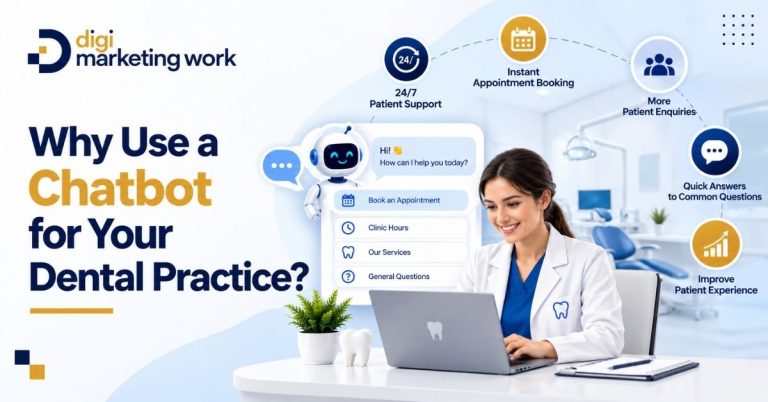
A chatbot can make the initial patient enquiry process more convenient while reducing repetitive administrative work for dental practices in Melbourne and across Australia. It is another way that patients can interact with your dental practice.
A dental chatbot is an AI-powered website assistant that can respond to routine patient questions, provide practice information, capture enquiries and support appointment requests.
Patients do not always contact a dental practice during reception hours. They may be researching treatments after work, comparing practices on the weekend or looking for an appointment when your team is already busy.
With the help of a dental chat bot, the patient journey becomes simpler:
Website visit → Question → Answer → Enquiry → Appointment
For dental practices, the goal is not to replace reception staff. It is to reduce repetitive enquiries and make it easier for patients to take the next step.
Key Takeaways
- A dental chatbot answers routine questions, captures enquiries and supports appointment requests, including outside reception hours.
- It supports your reception and clinical teams rather than replacing them, with a human handoff for anything complex, urgent or sensitive.
- It doesn’t create demand; it helps convert the website traffic you already have, so results depend on your site and setup.
- The best setups answer only from content your practice has approved, which keeps responses accurate and easy to review.
- A chatbot should never diagnose, give individualised clinical advice or make claims such as guaranteed or pain-free results.
- Chat content counts as advertising under Ahpra’s rules, and the Privacy Act applies to any personal or health information it collects.
- From 10 December 2026, new privacy policy disclosures apply to certain automated decision-making, so review your policy before then.
- Launch with tested answers, then read the transcripts regularly and keep practice information up to date.
What Is a Dental Chatbot?
A dental chatbot is an AI-powered assistant that communicates with website visitors through a chat window.
Depending on how it is configured, it can:
- Answer common questions about your dental practice
- Provide information about services
- Capture new patient enquiries
- Support appointment requests
- Collect callback requests
- Direct visitors to online booking
- Gather basic information before reception follows up
- Escalate complex or sensitive enquiries to your team
Modern AI chatbots can understand natural language rather than relying only on pre-set buttons. This allows patients to ask questions in their own words.
How Does a Dental Chatbot Work?
A typical interaction follows five stages:
- Receives a question: A visitor enters a query on the dental website.
- Interprets the request: AI identifies whether the visitor needs practice information, booking assistance or another type of support.
- Retrieves approved information: The chatbot searches its practice-specific knowledge base.
- Provides a response: It answers using the available information and configured rules.
- Escalates when necessary: It directs clinical, urgent or complex enquiries to an appropriate team member.
Some dental AI chatbots use retrieval-augmented generation (RAG), which retrieves relevant information from an approved knowledge base before generating an answer.
This approach helps ground responses in practice-approved content. However, it does not eliminate errors, so testing and human oversight remain essential.
Chatbots can also connect with supported booking platforms or enquiry management systems through integrations. Access should be limited to the information and functions the chatbot actually needs.
Benefits of Dental Chatbots
Dental AI chatbots improve communications around the clock, smoothen web traffics and administrative tasks. They also help organise dental practice’s workflow and handle enquiries. Below are more benefits of dental chatbots:
Give Patients Answers Around the Clock
Patients do not always research dental services or look for appointments during reception hours. They may browse your website in the evening, compare practices over the weekend or look for information during a lunch break.
A chatbot can provide access to approved practice information whenever someone visits your website. Patients can ask about opening hours, available services, locations, appointment procedures and contact options without waiting for reception to reopen.
This is particularly useful for practices that receive enquiries outside normal business hours.
Rather than leaving visitors without a clear next step, your website can continue accepting appointment and callback requests. Your reception team can then review those enquiries and respond during business hours.
Capture Enquiries Before They Are Lost
A potential patient may leave your website if they cannot quickly find an answer or contact your practice.
A chatbot can capture the enquiry instead of leaving the visitor with no clear next step. It can collect basic details and pass the request to your team for follow-up.
This is especially useful when your reception team is handling calls, checking patients in or dealing with other enquiries.
Reduce Repetitive Work for Reception Teams
Dental reception staff often answer the same questions throughout the day:
- What are your opening hours?
- Are you accepting new patients?
- Do you treat children?
- Do you offer dental implants?
- How can I request an appointment?
- Where is your practice located?
- Can I request a callback?
Although these questions are straightforward, responding to them repeatedly can interrupt other tasks, particularly when reception staff are checking patients in, processing payments or managing telephone enquiries.
A dental bot can handle these routine questions using information approved by your practice. This allows reception staff to concentrate on conversations that need personal attention, including appointment coordination, patient concerns and more complex administrative matters.
The objective is not to eliminate the human element of patient communication. It is to reduce avoidable interruptions and help your team use its time more effectively.
Make the Website Easier to Use
Dental websites often contain multiple service pages, from general dentistry to implants and cosmetic treatments.
A chatbot can help guide visitors from:
Question → Information → Enquiry → Appointment
An AI dental assistant can help visitors find relevant information without searching through several menus. For example, someone enquiring about missing teeth can be directed to the practice’s implant dentistry page without receiving a treatment recommendation.
Support a Smoother Patient Enquiry Journey
A chatbot can help structure appointment requests by collecting useful information before the enquiry reaches reception.
For example, it may ask:
- Are you a new or existing patient?
- What service are you enquiring about?
- What appointment time would you prefer?
- How can we contact you?
This gives your team more context and reduces unnecessary back-and-forth communication.
If your practice uses online booking, the chatbot can also direct patients to your booking system or, where supported, connect directly with it.
How Are AI Chatbots Used in Dentistry?
Chatbots for dentists are most useful when they support the administrative side of patient communication. They can help patients find information and initiate contact without attempting to perform the work of a dental professional.
Patient Enquiries and Practice Information
An AI dental assistant can answer routine questions about:
- Opening hours, location and contact details
- Whether the practice accepts new patients
- Services available at the clinic
- General appointment procedures
- Accepted payment methods, where this information is available
- How to contact reception
These answers should come from current, practice-approved information rather than generic AI responses.
Appointment Support and Lead Capture
Depending on its configuration, a chatbot can:
- Collect appointment requests
- Accept callback requests
- Provide booking links
- Explain how to reschedule an appointment
It can also gather the basic information reception needs to follow up.
Some systems integrate directly with supported booking platforms, while others simply direct patients to the existing booking page. The level of automation depends on the practice’s software and the capabilities of the chatbot.
Service Discovery and Website Navigation
Patients may describe what they are looking for without knowing the name of the relevant service.
For example, someone interested in improving the appearance of their teeth could be directed to the practice’s cosmetic dentistry page. Someone looking for information about missing teeth could be directed to the relevant restorative or implant dentistry page.
The chatbot should provide navigation and factual service information, not assess suitability or recommend treatment.
Human Handoff for Complex Conversations
Not every conversation should remain automated.
A chatbot should recognise when a patient needs a receptionist, registered dental practitioner or another appropriate member of the team. This includes complaints, sensitive matters, clinical questions, urgent concerns and direct requests to speak to a person.
The system should provide a clear handover route rather than repeatedly offering automated responses that do not address the person’s needs.
Can a Dental Chatbot Help Generate More Appointments?
It can help, with a caveat. A chatbot doesn’t create demand. It converts more of the website traffic you already have. How much difference it makes depends on your traffic, your website and how the chat is set up, so no honest provider can promise a specific result.
Turn Website Conversations Into Appointment Opportunities
Without a chatbot, the prospective patient may need to search through multiple pages, locate the contact form and wait for a response. With a well-configured chatbot, the visitor can ask a question, receive approved general information, access the relevant service page and request an appointment or callback.
- Instant Engagement: A visitor asks a question (such as pricing, insurance coverage, or procedure details) and receives an immediate reply instead of leaving the site.
- Guided Conversion: The chatbot moves the user smoothly from curiosity to a call-to-action, avoiding the drop-off that happens when a visitor has to hunt for a phone number or contact form.
- Real-Time Guidance: Using natural language processing, the system answers context-specific questions and directs the patient straight to a scheduling prompt.
Support After-Hours Enquiries
When reception is closed, a chatbot can continue answering routine questions and collecting enquiries.
- 24/7 Availability: Up to 40% to 50% of new patient booking demand happens outside of regular office hours when reception is closed.
- Round-the-Clock Action: Even at night or on weekends, visitors can ask questions, submit an enquiry, request a staff callback, or complete self-booking directly through tools like BotPenguin Dental Chatbots.
Connect Visitors With Online Booking
Many chatbots can link to an existing online booking platform. Some offer deeper integrations that allow them to pass appointment requests into supported systems or display available time slots.
- Direct Integration: Linking the chatbot to your practice management system (PMS) or calendar software removes friction.
- Fewer Steps: Patients can view open slots and lock in an appointment inside the chat window without waiting for a morning phone call from the front desk.
Collect Useful Information Before Reception Follows Up
A chatbot can collect basic details before reception follows up, including:
- New or existing patient status
- Service of interest
- Preferred appointment time
- Name and contact details
It can also direct visitors to an existing online booking system. Collect only the information necessary to handle the enquiry.
What Can a Dental Chatbot Answer?
A dental chatbot can answer routine administrative, scheduling, and general service questions based on the information published by the practice, while routing clinical or diagnostic queries to a human team.
Practice information
- Opening hours: Provides daily operating hours and holiday schedules.
- Location: Shares clinic addresses, parking details, and directions.
- New patients: Confirms whether the practice is currently accepting new patients.
- Contact details: Provides official phone numbers, email addresses, and communication channels.
Appointment enquiries
- Requesting appointments: Checks calendar availability and books or captures request details for new and existing visits.
- Callback requests: Records a patient’s name, phone number, and reason for visit so staff can call back.
- Rescheduling: Handles rescheduling or cancellation requests by updating or flagging calendar slots.
Service information
Patients may not always know the name of the treatment they are looking for. A chatbot can help direct them to the relevant service page without attempting to diagnose their condition or recommend treatment.
- Specific treatments: Explains general information for services like dental implants, cosmetic dentistry, and teeth whitening.
- Emergency care: Outlines whether emergency care is provided and collects symptom details to help staff assess urgency.
- Patient demographics: Clarifies if the clinic treats children or provides specialised pediatric care.
General administrative information
- Payment methods: Lists accepted credit cards, cash policies, dental insurance plans, and financing options.
- Appointment process: Explains what happens during a first visit and expected consultation lengths.
- Preparation: Tells patients what to bring, such as a photo ID, insurance cards, or previous dental records.
Escalate to Your Team
A good chatbot should know when it needs to hand the conversation to a person.
This may include:
- Clinical questions
- Complaints
- Urgent concerns
- Sensitive situations
- Complex enquiries
- A direct request to speak with someone
The objective is not to keep every conversation automated. It is to make sure the patient reaches the right person efficiently.
Note: A dental chatbot does not provide medical diagnoses, treatment planning, or clinical advice. Any symptom-specific or clinical question is escalated to a dentist or front-desk staff.
What Should a Dental Chatbot Not Do?
The boundaries matter as much as the capabilities.
Make a Diagnosis
A chatbot should never tell a patient they definitely have a particular dental condition. Software that diagnoses or recommends treatment can also fall under Therapeutic Goods Administration (TGA) rules for medical device software, which is a good reason to keep a front-desk chatbot strictly administrative.
Give Individualised Clinical Advice
It shouldn’t recommend a treatment, medication, treatment plan or clinical decision based on someone’s personal circumstances. That’s a conversation for a registered practitioner.
Make Unverified Treatment Claims
Chatbot replies promote your services, so they must avoid the claims Ahpra’s advertising rules warn against, such as:
- Guaranteed results or outcomes
- Permanent results
- Pain-free treatment
- “Best” treatment
Handle Situations That Require a Dental Professional
The conversation should move quickly to a qualified member of your team for clinical questions, complaints, sensitive matters and complex patient circumstances. Urgent concerns need special care. If someone describes facial swelling that affects breathing or swallowing, or bleeding they can’t control, the bot should tell them to call your practice’s emergency line or 000 immediately, not continue chatting.
Are Dental AI Chatbots Safe for Patient Information?
It depends on how the chatbot is built and managed. In Australia, health information is treated as sensitive information under the Privacy Act 1988, and health service providers are covered by the Act regardless of the size of the practice. A dental AI chatbot that collects names, phone numbers or descriptions of dental problems is collecting personal information, sometimes health information, so it needs to be set up carefully.
- Collect only what you need: A name and contact number is usually enough to arrange a callback. Don’t ask for dental history in a chat window.
- Say it’s automated: Patients should know they’re talking to an automated assistant, and how to reach a person.
- Know where the data lives: Ask the provider where conversations are stored. If data is sent to servers overseas, the overseas disclosure rules in Australian Privacy Principle 8 apply, and your practice stays accountable.
- Review third-party integrations: Every connected tool, from booking software to email platforms, is another place the data travels.
- Control access: Only the people who need transcripts should be able to see them, protected by strong logins.
- Set a retention period: Decide how long chat logs are kept, and what happens to them afterwards.
- Keep humans in the loop: Someone on your team should own the chatbot and review how it performs.
- Offer another way to reach you: Always show a phone number or contact form for people who prefer not to use chat.
Practices should also have a plan for data breaches, since the Notifiable Data Breaches scheme can apply to health service providers.
What Should Practices Know About Privacy Changes in December 2026?
From 10 December 2026, additional privacy policy transparency requirements apply to relevant organisations using certain automated decision-making processes that could significantly affect an individual’s rights or interests.
Australian Privacy Principle (APP) entities and businesses using computer programs for automated decision-making must update their privacy policies under the Privacy and Other Legislation Amendment Act 2024
A chatbot that answers FAQs may not trigger these requirements. However, systems that automatically screen or decline bookings using personal information warrant closer assessment.
Review the Office of the Australian Information Commissioner’s privacy guidance and seek professional advice where necessary.
What Should Australian Dental Practices Check Before Using a Chatbot?
AHPRA and Dental Advertising Requirements
Chatbot content that promotes dental services should be factual, accurate and supportable.
Review the Ahpra advertising guidelines to understand requirements concerning misleading claims, unreasonable expectations of treatment benefits and testimonials.
Have a registered practitioner review service descriptions and promotional responses before launch.
Privacy and Patient Information
Check what the chatbot collects, where information is stored, who can access it and whether third parties receive it.
Ensure that the practice’s privacy information accurately describes the system and that appropriate security controls are in place.
Accuracy of Practice Information
A chatbot is only as reliable as the information it uses.
Outdated opening hours, incorrect fees, unavailable services or inaccurate booking instructions can frustrate patients and create additional work for reception.
Assign a team member to maintain the chatbot’s knowledge base and update it whenever practice information changes. Where possible, use a controlled source of approved information rather than several conflicting documents.
Ongoing Review and Human Oversight
Decide who is responsible for monitoring conversations, reviewing incorrect answers and handling escalated enquiries.
Staff should know how chatbot enquiries reach them, how quickly they should respond and what to do when the system cannot answer a question.
Regular oversight helps identify problems before they become recurring issues.
Which Features Matter When Choosing a Dental AI Assistant?
If you are considering a chatbot for your practice, look for features that support both patients and your reception team.
- 24/7 availability: Patients can make enquiries outside reception hours.
- Natural language understanding: Patients can ask questions naturally.
- Practice-specific information: Responses are based on information approved by your practice.
- Appointment integration: Connects with your existing booking process where possible.
- Lead capture: Collects appropriate enquiry details.
- Human handover: Allows staff to take over when needed.
- Mobile compatibility: Works properly on smartphones.
- Easy updates: Your team can update information when services, hours or policies change.
- Conversation reporting: Shows what patients are asking and where conversations are failing.
- Privacy controls: Provides appropriate controls for handling patient information.
A chatbot should also be easy for your team to manage. If updating a simple answer requires technical support every time, it can quickly become difficult to maintain.
How Can You Measure Whether a Dental Chatbot Is Working?
Installing a chatbot is only the beginning. To determine whether it is helping your practice, measure its performance against clear administrative and patient acquisition objectives.
Monitor Conversations and Engagement
Start with basic usage data:
- Conversations started
- Questions asked
- Conversations completed
- Unanswered questions
- Conversations transferred to staff
These metrics help you understand how visitors use the chatbot and identify areas that need improvement.
For example, frequent unanswered questions may indicate that the knowledge base is incomplete or that your website does not clearly explain a particular service.
Measure Enquiries and Appointment Actions
Track the actions that matter to your practice, including:
- Enquiries captured
- Callback requests
- Appointment requests submitted
- Clicks on online booking links
- Service-related enquiries
Where your analytics setup permits, use Google Analytics 4 and Google Tag Manager to measure relevant interactions. Ensure events are configured correctly and avoid sending identifiable patient information or sensitive health details to analytics platforms.
A booking link click should not be counted as a confirmed appointment. Keep these actions separate so your reporting reflects what actually happened.
Follow the Journey to New Patients
Where appropriate tracking is available, assess the journey from chatbot interaction to enquiry, booked appointment and new patient.
Chat interaction → Enquiry → Appointment → New patient
Attribution may not always be straightforward. Someone might interact with the chatbot and later call reception or book through another channel.
Your team can help by recording how new patients found the practice and using consistent enquiry and booking records. Compare results over time rather than assuming that every appointment following a chatbot conversation was caused by the chatbot.
What Mistakes Should Dental Practices Avoid With Chatbots?
A poorly configured chatbot can add friction rather than reduce it. Avoid these common mistakes when implementing AI in your practice.
- Automating too much: Keep clinical decisions, complex enquiries and sensitive conversations with appropriately qualified people.
- Collecting excessive information: Ask only for the details needed to handle the enquiry.
- Providing no human handover: Make it easy for visitors to contact reception when the chatbot cannot help.
- Using outdated information: Regularly review services, fees, opening hours and booking instructions.
- Making unsupported claims: Ensure automated responses follow the same advertising standards as other practice communications.
- Asking too many questions: Keep the initial conversation focused on the visitor’s immediate need.
- Launching without adequate testing: Test common questions, unusual phrasing, failed integrations and escalation scenarios.
- Ignoring conversation data: Review unanswered questions and incorrect responses instead of treating the chatbot as a set-and-forget tool.
- Focusing on technology rather than workflow: Choose features that address real reception challenges rather than adding unnecessary steps.
A chatbot should simplify the first stage of patient communication. If it creates extra work for staff or makes it difficult for patients to reach a person, its design needs to be reconsidered.
How Can a Dental Practice Get Started With a Website Chatbot?
1. Identify the Questions Reception Answers Most Often
Review recurring questions from phone calls, emails, website forms and existing FAQs.
Start with the enquiries that consume the most time but require straightforward, factual answers. These are usually the easiest tasks to automate responsibly.
2. Define What the Chatbot Can and Cannot Handle
Establish clear boundaries for routine administration, appointment requests, clinical questions, complaints and urgent concerns.
Document when the chatbot should provide an answer, when it should direct visitors to another resource and when it must hand over to a person.
3. Build an Approved Practice Knowledge Base
Prepare accurate information about your services, locations, opening hours, booking procedures, contact details and relevant policies.
Have the appropriate members of the practice review and approve this content. The chatbot should not invent answers when information is missing.
4. Establish Privacy and Escalation Rules
Decide what information the chatbot may collect, how it will be stored and who can access it.
Define the process for escalating clinical questions, complaints, urgent concerns and other sensitive interactions. Include clear instructions for situations that require emergency assistance.
5. Connect the Chatbot to Existing Enquiry and Booking Systems
Where appropriate, connect the chatbot to your online booking platform, contact forms or enquiry management process.
Confirm that requests reach the correct team, that integrations work as expected and that patients receive accurate confirmation of what has or has not been booked.
6. Test Before Going Live
Test the chatbot on desktop and mobile devices using common questions, spelling variations and unexpected requests.
Include questions it should not answer, such as requests for a diagnosis or individualised treatment advice. Confirm that it declines appropriately and offers a suitable handover.
Test urgent escalation instructions, privacy notices and integration failures before making the chatbot available to patients.
7. Review and Improve Performance After Launch
Monitor conversations closely during the initial rollout. Correct inaccurate responses, add missing information and refine escalation rules.
Review the results regularly to determine whether the chatbot is reducing repetitive enquiries, improving response pathways and generating useful appointment opportunities.
Is a Dental Chatbot Right for Your Practice?
A chatbot may be worth considering if your practice:
- Receives a high volume of repetitive enquiries
- Gets website visitors outside reception hours
- Misses enquiries while the team is busy
- Receives frequent appointment questions
- Wants to make online enquiries easier
- Has an existing online booking system
Smaller practices can also benefit, particularly when reception is busy or patients frequently enquire outside business hours.
However, a chatbot should not be the first priority if your website receives very little relevant traffic. Improving your website, SEO and other patient acquisition channels may need to come first.
For practices in Melbourne, investing in SEO services and a clear website structure can help prospective patients discover relevant services. A chatbot can then support the next step by making it easier for those visitors to ask questions and submit enquiries.
Frequently Asked Questions About Dental Chatbots
What is a dental chatbot?
It’s an AI-powered chat assistant on a dental practice’s website that answers routine questions, shares practice information and captures enquiries and appointment requests.
What is an AI dental assistant?
The term is often used for AI tools that support a dental practice’s administration. It can include a website chatbot, but may also cover voice assistants, reminders and other front-desk tasks.
Are dental AI chatbots safe for patient information?
They can be, if they’re set up well. That means collecting only necessary information, knowing where data is stored, controlling access and reviewing the provider’s security and privacy practices. See the safety section above for the details.
Does every dental practice need a chatbot?
No. A chatbot tends to suit practices that receive plenty of repetitive enquiries or website traffic outside reception hours. A practice with little web traffic may get more value from improving visibility first.
What is the difference between a dental chatbot and an AI dental assistant?
In everyday use the two overlap heavily. “Chatbot” typically means the website chat window, while “AI dental assistant” is a broader label that may include other admin tasks beyond chat.
Can a dental chatbot work with an existing booking system?
Often, yes. It depends on what your booking platform supports. At minimum, the chatbot can link patients to your booking page; deeper integrations may show availability or pass requests straight to your system.
Can patients use a dental chatbot on a mobile phone?
Yes. A well-built chat widget is designed for phone screens, which matters because many patients will find you on their mobile.
Does a dental chatbot need access to a practice’s patient records?
Not for an enquiry chatbot. It should work from your approved public information, and any booking integration should be limited to appointment availability, not clinical notes.
Can a dental chatbot speak with patients in multiple languages?
Many AI chatbots can reply in a range of languages. Have a fluent speaker check the translated content for accuracy, and keep clinical conversations with a qualified person or interpreter.
How much does a dental chatbot cost?
It varies. Costs usually depend on setup and knowledge-base work, integrations, conversation volume and ongoing support. Ask providers for a clear breakdown of setup and recurring costs.
Can a dental chatbot be added to an existing dental website?
Yes. Most chat widgets are added to an existing site with a small piece of code, without rebuilding the website.
Is a Dental Chatbot a Replacement for Reception Staff?
No. It handles routine questions and captures enquiries so your team has more time for the conversations that need warmth and judgement.
Final Thoughts
A dental chatbot won’t replace your team, and it can’t diagnose or promise results. What it can do is answer routine questions at any hour, capture enquiries that would otherwise slip away and give your reception staff more room for patients who need a person. Set up with approved content, clear boundaries, privacy safeguards and regular review, it’s a practical addition to a dental practice website.
As a dental digital marketing agency in Australia, Digi Marketing Work can develop a dental chatbot tailored to your practice, built around your approved information and your enquiry process. To see how it fits alongside the rest of your online presence, explore our dental practice marketing services or browse our other dental guides.
Contact us for more details on your dental marketing practice and how you can use AI for a streamlined process.