For many Melbourne dental clinics, Google Ads is one of the fastest ways to reach someone who needs an appointment right now. A person with a toothache types “emergency dentist Melbourne” and your ad appears at the exact moment they’re ready to book. That’s powerful, and it’s why paid search has become a core patient acquisition channel.
But the same power can burn through a budget quickly. Poorly managed campaigns collect irrelevant clicks, target the wrong areas, and send visitors to pages that don’t convert, so the money disappears and the phone stays quiet. Most of these Google Ads mistakes are fixable once you know where to look.
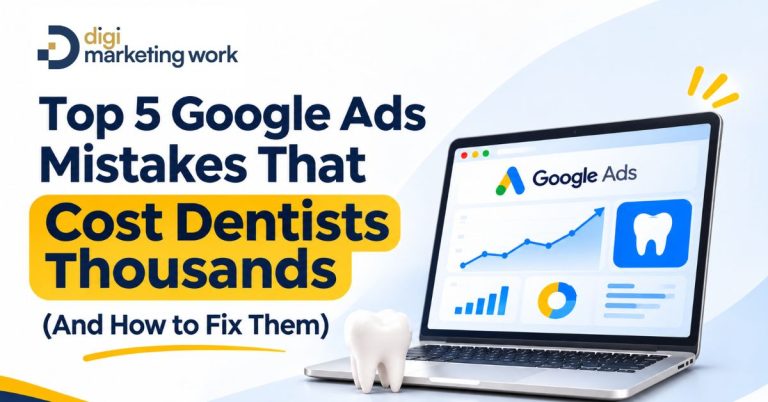
In this guide, we walk through the top five most common mistakes dentists make, and exactly how to fix each one. We also explain why successful campaigns are never “launch and leave”, and look at the disadvantages of Google Ads so you can plan with your eyes open.
Key Takeaways
- Target a practical radius around your clinic, roughly 5 to 10 km depending on your catchment, and review location reports often.
- Bid on treatment-specific, location-based keywords, and keep your negative keyword list growing with every search term review.
- Send each ad to a dedicated landing page that matches the treatment advertised, not your homepage.
- Write treatment-specific ad copy with a clear call to action, and add sitelinks, callouts and call assets.
- Track phone calls, forms and online bookings, then judge campaigns by cost per qualified enquiry, not clicks.
- Google Ads needs ongoing optimisation. “Set and forget” is the most expensive mindset of all.
- Dental advertising in Australia must comply with AHPRA and Dental Board rules, including the ban on testimonials.
1. Ignoring Location Targeting and Attracting Irrelevant Clicks
The Mistake
Many clinics target a huge area, sometimes all of Victoria, because it feels safer to cast a wide net. The result is clicks from people who’ll never travel to your practice. Patients rarely cross the city for a routine check-up, so ignoring Melbourne suburbs and local search behaviour wastes the budget on people who were never going to book.
How to Fix it
- Target a practical radius. For most clinics, a 5 to 10 km radius works well, though a clinic near a major transport hub or in a regional pocket may need a different catchment.
- Create location-specific campaigns. Separate campaigns for key suburbs let you adjust bids and write more relevant ad copy.
- Review location reports regularly. See which suburbs deliver quality enquiries, not just clicks.
- Exclude poor performers. If certain areas keep generating irrelevant traffic, exclude them.
2. Using Broad Keywords Without Proper Negative Keyword Management
The Mistake
Bidding on generic terms like “dentist”, “dental clinic” or “teeth cleaning” without thinking about search intent is a classic Google Ads mistake. Those searches include people looking for dental jobs, courses, free services or DIY treatments. Informational searches also sit alongside people actively looking for an appointment, and a broad keyword can’t tell them apart.
How to Fix it
- Prioritise treatment-specific and location-based keywords, such as “emergency dentist Melbourne” and “dental implants in Melbourne”.
- Use appropriate match types so you control how closely searches must match your keywords.
- Review the search terms report regularly to see what people actually typed before clicking.
- Add negative keywords such as “dentist salary”, “dental courses” and “DIY teeth whitening” where relevant.
- Group keywords by treatment and patient intent, so ads and landing pages stay closely matched.
3. Sending Ad Traffic to Generic or Poorly Designed Landing Pages
The Mistake
Sending every click to the homepage, whatever treatment the ad promised, is one of the costliest habits in dental advertising. Someone who clicked “Invisalign” shouldn’t have to hunt through menus to find Invisalign. Pages with unclear calls to action, slow loading speeds or complicated booking forms lose people quickly, and you’ve already paid for the click.
How to Fix it
- Create dedicated landing pages for treatments such as Invisalign, dental implants, emergency dentistry and teeth whitening.
- Match the page to the ad, so the message and intent line up from click to page.
- Make booking easy, with clear appointment options, contact details and relevant treatment information.
- Optimise for mobile, because many dental searches happen on phones, often urgently.
- Build trust with credentials and clinic information, such as dentist registration details, qualifications and practice facilities.
Compliance note: In Australia, advertising for regulated health services, including your website and landing pages, must not use testimonials under section 133 of the Health Practitioner Regulation National Law. Check AHPRA and Dental Board guidance before publishing reviews or before-and-after material.
4. Writing Weak Ad Copy Without Clear Calls to Action
The Mistake
Generic ads like “Quality Dental Care for Everyone” say nothing and set you apart from no one. They skip treatment information and next steps, and they often ignore the extra Google Ads assets that give people more reasons to click.
How to Fix it
- Write treatment-specific headlines and descriptions that mirror what patients search for.
- Highlight useful clinic details, like appointment availability and payment options, where applicable.
- Use clear CTAs such as “Book an Appointment” or “Enquire About Treatment”.
- Add sitelinks, callouts and call assets to give additional information and make calling easy.
- Test ad variations to learn which messages bring better-quality enquiries, not just more clicks.
5. Not Tracking Conversions or Optimising Campaign Performance
The Mistake
If success is measured by clicks and impressions alone, you can’t tell whether ads are bringing patients. Many clinics don’t track phone calls, contact form submissions or online bookings, so they keep spending on keywords and ads without knowing what’s actually working. That’s one of the quietest Google Ads pitfalls, because the dashboard can look healthy while the diary stays empty.
How to Fix it
- Set up conversion tracking in Google Ads, alongside Google Analytics 4 and Google Tag Manager where appropriate.
- Track phone calls, form submissions and online bookings as separate conversions.
- Monitor cost per conversion and conversion rate for each campaign.
- Identify which campaigns, keywords and ads generate qualified enquiries, and which don’t.
- Use that data to guide bidding and budget decisions, shifting money toward what works.
Bonus Mistake: Why Should Dentists Avoid the “Set and Forget” Google Ads Mindset?
Launching a campaign is only the beginning. Search behaviour shifts, competitors adjust their bids, costs change and your own offers evolve, so a campaign that performed well in March can quietly decline by June.
Regular maintenance should include:
- Search term analysis to catch new irrelevant queries
- Negative keyword updates as new patterns appear
- Ad copy testing to improve click-through and enquiry quality
- Landing page improvements based on how visitors behave
- Budget adjustments toward your best-performing campaigns
- Conversion performance monitoring to see real patient outcomes
Ongoing optimisation is what stops wasted spending. A good partner treats your campaign as a living asset. If you’d rather not manage this yourself, a Google Ads agency Melbourne clinic can brief on a monthly basis and can take much of that load off your team.
How Do Google Ads Work for Dental Clinics?
Google Ads lets your clinic appear at the top of search results when someone searches for a dental treatment. You choose keywords, write ads and set a budget, then Google runs an auction every time a relevant search happens.
- Auctions: Your bid matters, but so does quality. Google weighs ad relevance, expected click-through rate and landing page experience when deciding who appears and how much you pay.
- Keywords and search intent: The words people type reveal what they want. “Dental implants cost Melbourne” suggests research, while “emergency dentist open now” suggests urgency.
- Ad relevance and landing page experience: The closer your ad, keyword and page match, the better your performance tends to be.
- Local treatment targeting: You can aim at patients searching for specific treatments in specific Melbourne suburbs.
- Pay-per-click (PPC): You pay when someone clicks your ad, not when it’s shown.
What Are the Advantages of Google Ads for Dentists?
The advantages of Google ADs for dentist are:
Highly Targeted Advertising
You reach people actively searching for specific dental treatments, not a general audience scrolling past.
Local Patient Reach
You can target potential patients in the Melbourne suburbs and surrounding areas your clinic serves.
Immediate Search Visibility
Paid ads can appear in search results without waiting for organic rankings to improve.
Flexible Advertising Budget
You can raise or lower budgets based on clinic capacity, competition and marketing goals.
Measurable Campaign Performance
You can monitor clicks, enquiries, conversions and costs to judge what’s working.
What Are the Disadvantages of Google Ads for Dental Practices?
Honest planning means understanding the disadvantages of Google Ads as well as the benefits.
Increasing Advertising Costs
Competitive dental keywords can make patient acquisition expensive, especially in busy metropolitan markets.
Steep Learning Curve
Campaign setup, keyword research, bidding and optimisation all need specialised knowledge.
Dependence on Paid Traffic
When campaigns are paused or budgets run out, your visibility drops with them.
Ongoing Management Requirements
Campaigns need regular monitoring and optimisation to stay efficient.
Landing Page Dependency
A poor website experience reduces the chance of converting paid traffic into enquiries.
Short-Term Results vs. Long-Term Growth
Google Ads can generate immediate visibility, but sustainable organic visibility takes a longer-term SEO strategy.
What Is a Good Google Ads Budget for a Dental Clinic in Melbourne?
There’s no single right number. A sensible budget depends on:
- Treatment competition: Cost per click is shaped by how many clinics are bidding on the same terms.
- Treatment type: Emergency dentistry, dental implants and cosmetic dentistry usually carry different costs, because competition and the value of a new patient differ.
- Clinic capacity: There’s no point generating more enquiries than your team can handle.
- Treatment profitability and patient demand: Spend should follow the treatments that matter most to your practice.
Tentative Google Ads Costs for Melbourne Dental Clinics (2026)
To help you plan, here are indicative ranges based on 2026 industry benchmarks for Australia and similar markets. Treat them as starting points only. Published figures vary widely, national averages often sit below what busy Melbourne suburbs actually pay, and your own costs will depend on competition, quality scores and landing page performance. Check current estimates in Google Keyword Planner before you commit.
Typical cost per click (AUD, tentative)
| Treatment focus | Tentative cost per click |
| General dentistry (“dentist near me”) | AUD 5 to 15 |
| Emergency dentist | AUD 12 to 20 |
| Invisalign and orthodontics | AUD 6 to 20 |
| Dental implants | AUD 10 to 25+ |
Typical cost per enquiry (AUD, tentative)
| Campaign type | Tentative cost per enquiry |
| General and emergency dentistry | AUD 30 to 110 |
| Implants and cosmetic treatments | AUD 130 to 250+ |
Higher-value treatments cost more per enquiry, but each patient is also worth far more, so a higher cost can still be profitable.
Tentative monthly ad spend by clinic type (AUD, excluding agency fees)
| Clinic type | Tentative monthly ad spend |
| Single clinic testing general and emergency dentistry | AUD 1,500 to 3,000 |
| Growing clinic adding Invisalign or implants | AUD 3,000 to 6,000 |
| Competitive suburb or multi-location group | AUD 6,000 to 10,000+ |
A few practical notes:
- Don’t go too thin. Budgets below roughly AUD 1,500 to 2,000 a month often don’t collect enough data for Google’s automated bidding to learn properly.
- Don’t split evenly. Many practices weigh a share of the budget (commonly 20 to 30%) toward emergency campaigns, which tend to convert well, then add implants and cosmetic work as results come in.
- Management fees are usually separate. The figures above are what goes to Google, not what an agency charges.
- Start lean, then scale. Run a focused campaign for several weeks, review cost per qualified enquiry, and increase spend only where enquiries are turning into booked patients.
One practical way to set a realistic monthly budget is to work backwards from your goal:
- Decide how many new patients you want from ads each month.
- Estimate what share of enquiries turn into booked appointments.
- Divide your target by that share to find the enquiries you need.
- Multiply by your expected cost per qualified enquiry.
Illustrative example: If you want 10 new patients, and one in three enquiries books, you need about 30 enquiries. At an assumed AUD 80 per enquiry, that points to roughly AUD 2,400 a month. Use your own figures, not these.
Evaluate cost per qualified enquiry, not clicks alone. A cheap click that never books is more expensive than a pricier one that does.
How Can Dentists Build a More Effective Google Ads Strategy?
Dentist can build more effective Google ADs strategy by:
- Define clear campaign objectives, such as new patient enquiries for a specific treatment.
- Conduct treatment-specific keyword research based on real patient searches.
- Develop location-based targeting around your catchment.
- Create dedicated landing pages for each core treatment.
- Write relevant, compelling ads with clear calls to action.
- Implement conversion tracking across calls, forms and bookings.
- Monitor performance and optimise regularly.
- Combine paid ads with SEO and other digital marketing. Your ads work harder when your clinic also shows up in organic results, on Google Maps and on social platforms.
A solid dental marketing SEO foundation, supported by social media marketing Melbourne patients actually use, makes every ad dollar go further. And as more people ask AI tools for local recommendations, generative AI SEO services can help your clinic stay visible there too.
For a practical look at another tool that helps convert visitors, dentists can use a chatbot for your dental practice.
Which Is Better for Dentists: SEO or Google Ads?
Neither is “better” on its own; they do different jobs.
| Comparison | Google Ads | SEO |
| Visibility | Paid search visibility | Organic search visibility |
| Results | Can generate immediate visibility | Usually takes longer to build |
| Cost | Ongoing advertising spend | Investment in optimisation and content |
| Traffic | Depends on active campaigns | Can continue without paying for every click |
| Long-term value | Requires continued ad spend | Builds sustainable organic visibility |
| Best suited for | Immediate patient enquiries | Long-term search visibility |
Many clinics use ads for quick enquiries while building lasting visibility through affordable SEO Melbourne practices can sustain over the long term.
Conclusion: Turn Your Dental Google Ads Budget into More Patient Enquiries
Let’s recap the five Google Ads mistakes and their fixes:
- Location targeting: Focus on a practical radius around your clinic.
- Keywords: Use treatment-specific terms and keep negative keywords current.
- Landing pages: Match each ad to a dedicated, mobile-friendly page.
- Ad copy: Write treatment-specific copy with clear calls to action.
- Conversion tracking: Measure calls, forms and bookings, not just clicks.
Targeted keywords, careful location settings, relevant landing pages, compelling ad copy and accurate tracking work together, and none of them is a one-off task. Successful campaigns need continuous monitoring and optimisation, and a strategic approach to paid advertising.
If you’d like experienced help, Digi Marketing Work is a boutique digital marketing agency Melbourne dental clinics can work with directly.
Looking to attract more patients through Google Ads? Explore our Paid Ads Services and discover how a targeted advertising strategy can help your dental practice reach potential patients across Melbourne.
Ready to talk? Contact Digi Marketing Work today.
Frequently Asked Questions About Google Ads for Dentists
What are some common mistakes to avoid in Google Ads?
The big ones are targeting too wide an area, using broad keywords without negatives, sending traffic to the homepage, writing generic ad copy and failing to track conversions. Treating campaigns as “set and forget” makes all of them worse.
Are Google Ads still worth it for dentists in 2027?
Yes, for many clinics, provided campaigns are tracked and managed. Paid search still reaches people who are ready to book, but results depend on targeting, landing pages and cost per qualified enquiry. It works best alongside SEO, not instead of it.
Why are my Google Ads getting clicks but no dental appointment bookings?
Common causes include irrelevant keywords, poor location targeting, landing pages that don’t match the ad, slow or confusing booking forms, and missing conversion tracking. Check your search terms report and landing page first.
How long does it take for Google Ads to generate dental leads?
Enquiries can arrive within days of launch, because ads appear straight away. Allow several weeks of data and optimisation, though, before judging performance or making major changes.
Disclaimer: This article is general information about digital marketing and isn’t legal or regulatory advice. Dental practitioners should check the current AHPRA and Dental Board of Australia advertising requirements.