

If you’re a dentist or manage marketing for a dental practice, you’ve likely searched for terms like “dentist keywords,” “dentist SEO keywords,” or “SEO keywords for dentists” hoping to find the best way to attract more patients online. While identifying high-volume keywords is important, ranking well in today’s search results requires a much more strategic approach.
Google’s search experience has changed dramatically over the past few years. Traditional organic rankings are now accompanied by Google AI Overviews, People Also Ask, local map results, and AI-powered search platforms such as ChatGPT, Perplexity, and Gemini. Instead of rewarding websites that simply repeat keywords, these platforms prioritise content that demonstrates expertise, answers patient questions clearly, and provides comprehensive coverage of a topic.
For Australian dental practices, this means your SEO strategy should go beyond targeting generic terms like “dentist near me.” Success now comes from combining treatment-based keywords, suburb-specific landing pages, educational content, and a strong local SEO strategy that reflects how patients actually search.
In this guide, you’ll learn:
- The 50+ most searched trending dental keywords Australia in 2026
- High-converting keywords that generate appointment enquiries
- Treatment-specific keyword opportunities
- Local and suburb-based keyword strategies
- Long-tail keywords with lower competition
- The best keywords for Google Ads campaigns
- How to optimise for AI-powered search and Google AI Overviews
- Common dental SEO mistakes to avoid
Whether you’re launching a new dental website or refining an existing SEO strategy, this guide will help you build a keyword plan that attracts qualified traffic and supports long-term growth.
Further Reading: If you’re looking to generate more enquiries beyond keyword research, explore our guide on How Dentists Get More Patients Online, where we cover proven strategies for increasing bookings through SEO, local search, and digital marketing.
Why Dental Keyword Research Matters in 2026
Keyword research remains the foundation of every successful dental SEO campaign, but the way search engines evaluate content has evolved significantly.
Patients are no longer searching using just one or two broad phrases. Instead, they ask highly specific questions such as:
- How much do dental implants cost in Australia?
- Emergency dentist open on Saturday
- Invisalign vs braces
- Family dentist near me
- Cosmetic dentist + Suburb
These searches reveal clear intent and give dental practices the opportunity to provide relevant, helpful content that meets patient needs.
At the same time, Google now places much greater emphasis on Experience, Expertise, Authoritativeness, and Trustworthiness (EEAT), particularly for healthcare websites. Since dental services fall under Google’s Your Money or Your Life (YMYL) category, search engines expect content to be accurate, trustworthy, and written with patient wellbeing in mind.
This shift has also changed the role of keyword research. Instead of chasing only the highest-volume terms, successful dental practices focus on:
- Matching keywords to patient intent.
- Creating dedicated treatment pages.
- Building suburb-specific landing pages.
- Publishing educational blogs that answer common patient questions.
- Strengthening topical authority through internal linking and content clusters.
A modern dental SEO strategy isn’t just about ranking, it’s about becoming the most trusted source of information for prospective patients.
If you’re planning to optimise your website for emerging search experiences, it’s also worth understanding How to Rank in AI Overview, where structured content and topical authority play an increasingly important role.
What Are Dental SEO Keywords?
Dental SEO keywords are the words and phrases people type into Google and other search engines when looking for dental treatments, oral health advice, or a nearby dental clinic.
These keywords help search engines understand what your website is about and determine which pages should appear in search results.
For example, someone searching for:
- Emergency dentist near me
- Invisalign Melbourne
- Teeth whitening cost
- Dental implants
- Children’s dentist Sydney
is actively looking for information or a service related to dental care.
The more closely your website matches these searches with high-quality, relevant content, the more likely it is to appear in front of potential patients.
However, not all keywords have the same purpose. Some users are researching treatments, while others are ready to book an appointment immediately. Understanding this difference allows you to create pages that align with each stage of the patient journey.
Types of Dental Keywords
A successful dental SEO strategy combines multiple keyword categories rather than relying on a single high-volume search term.
Commercial Keywords
Commercial keywords are used by patients who are comparing dentists or researching treatments before making a decision.
Examples include:
- Cosmetic dentist
- Family dentist
- Dental clinic
- Dental implants
- Invisalign
- Clear Aligners
These users have strong commercial intent and are likely to book after comparing providers.
Transactional Keywords
Transactional keywords indicate immediate booking intent.
Examples include:
- Emergency dentist near me
- Dentist open today
- Same-day dentist
- Complimentary implant consultation
- After hour emergency dentist
- Walk-in dentist
- Book dentist appointment
These searches typically deliver the highest conversion rates because the user needs treatment now.
Informational Keywords
Many patients begin their journey by researching symptoms, procedures, and treatment options.
Examples include:
- Is a root canal painful?
- How long do veneers last?
- Why do my gums bleed?
- How much do dental implants cost?
Educational content targeting these searches builds trust and often attracts visitors earlier in the decision-making process.
Local Keywords
Since dentistry is a location-based service, local SEO keywords are essential.
Examples include:
- Dentist Melbourne
- Dentist Sydney
- Emergency dentist Brisbane
- Family dentist Perth
- Cosmetic dentist Adelaide
Local keywords help practices appear in Google Maps, local search results, and AI-powered recommendations.
Long-Tail Keywords
Long-tail keywords are longer, more specific search phrases that usually have lower competition but stronger conversion potential.
Examples include:
- Affordable Invisalign Melbourne
- Emergency dentist open Sunday Sydney
- Best children’s dentist near me
- Dental implant specialist Brisbane
Although these searches may have lower monthly search volumes, they often generate more qualified leads because they closely match patient intent.
50+ Most Searched Dental Keywords in Australia
The following keywords represent some of the most searched dental-related terms in Australia across general dentistry, cosmetic treatments, emergency care, and local search. Rather than targeting every keyword on a single page, organise them into dedicated service pages, location pages, and educational content to maximise visibility.
| Keyword | Search Intent | Category |
| Dentist | Commercial | General Dentistry |
| Dentist near me | Transactional | Local SEO |
| Dental clinic | Commercial | General Dentistry |
| Family dentist | Commercial | General Dentistry |
| After-hour dentist | Commercial | General Dentistry |
| Cosmetic dentist | Commercial | Cosmetic Dentistry |
| Children’s dentist | Commercial | Paediatric Dentistry |
| Emergency dentist | Transactional | Emergency Dentistry |
| Emergency dentist near me | Transactional | Emergency Dentistry |
| Dental implants | Commercial | Implant Dentistry |
| Implant dentist | Commercial | Implant Dentistry |
| All on 4 implant | Commercial | Implant Dentistry |
| Invisalign | Commercial | Orthodontics |
| Platinum invisalign provider | Commercial | Orthodontics |
| Clear aligners | Commercial | Orthodontics |
| Braces | Commercial | Orthodontics |
| Fastbraces | Commercial | Orthodontics |
| Teeth whitening | Commercial | Cosmetic Dentistry |
| Zoom teeth whitening | Commercial | Cosmetic Dentistry |
| Take home teeth whitening | Commercial | Cosmetic Dentistry |
| Veneers | Commercial | Cosmetic Dentistry |
| Smile makeover | Commercial | Cosmetic Dentistry |
| Dental bonding | Commercial | Cosmetic Dentistry |
| Root canal treatment | Commercial | Endodontics |
| Root canal cost | Informational | Endodontics |
| Wisdom teeth removal | Commercial | Oral Surgery |
| Tooth extraction | Commercial | General Dentistry |
| Dental crown | Commercial | Restorative Dentistry |
| Dental bridge | Commercial | Restorative Dentistry |
| Dentures | Commercial | Restorative Dentistry |
| Gum disease treatment | Commercial | Periodontics |
| Bleeding gums | Informational | Periodontics |
| Dental cleaning | Commercial | Preventive Dentistry |
| Dental check-up | Commercial | Preventive Dentistry |
| Oral examination | Informational | Preventive Dentistry |
| Dental filling | Commercial | General Dentistry |
| Dental implant cost Australia | Informational | Pricing |
| Invisalign cost | Informational | Pricing |
| Veneers cost | Informational | Pricing |
| Teeth whitening cost | Informational | Pricing |
| Affordable dentist | Commercial | Pricing |
| BUPA dentist | Commercial | Pricing |
| CDBS dentist | Commercial | Pricing |
| Complimentary consultation | Commercial | Pricing |
| Dentist open Saturday | Transactional | Local SEO |
| Same-day dentist | Transactional | Emergency Dentistry |
| Walk-in dentist | Transactional | Emergency Dentistry |
| Kids dentist | Commercial | Paediatric Dentistry |
| Paediatric dentist | Commercial | Specialist Dentistry |
| Orthodontist | Commercial | Specialist Dentistry |
| Periodontist | Commercial | Specialist Dentistry |
| Prosthodontist | Commercial | Specialist Dentistry |
| Composite veneers | Commercial | Cosmetic Dentistry |
| All-on-4 dental implants | Commercial | Implant Dentistry |
| Dental implant specialist | Commercial | Implant Dentistry |
| Broken tooth repair | Transactional | Emergency Dentistry |
| Chipped tooth repair | Transactional | Emergency Dentistry |
| Missing tooth replacement | Commercial | Implant Dentistry |
| Oral hygiene | Informational | Preventive Dentistry |
SEO Tip: Instead of trying to rank one page for all these keywords, group related terms into topical clusters. For example, a Dental Implants page can naturally target related searches such as implant dentist, All-on-4 dental implants, missing tooth replacement, and dental implant cost Australia.
Most Profitable Dental Keywords
High search volume doesn’t always translate into more appointments. The most valuable keywords are those with strong commercial or transactional intent, where patients are actively looking to book treatment rather than simply researching.
Some of the highest-converting dental keywords include:
- Dentist near me
- Emergency dentist
- Emergency dentist near me
- Cosmetic dentist
- Family dentist
- Dental implants
- Implant dentist
- Invisalign
- Wisdom teeth removal
- Children’s dentist
These keywords often lead directly to enquiries because they align with services patients are ready to purchase.
For example:
- Someone searching “emergency dentist near me” usually needs immediate care and is likely to contact the first reputable clinic they find.
- A user searching “dental implants” or “Invisalign” is often researching high-value treatments and comparing providers before making a decision.
- Searches like “family dentist” typically indicate long-term patient intent, making them valuable for building lasting relationships with local families.
Rather than competing for every broad keyword, focus on building dedicated pages for your highest-value services, supported by educational content and location-specific landing pages. This approach strengthens topical authority while improving your ability to rank across a wider range of related searches.
Treatment-Based Dental Keywords
While broad keywords such as “dentist” or “dental clinic” are important for brand visibility, treatment-specific keywords often deliver higher-quality traffic because they align with what patients are actively searching for. Instead of creating one generic services page, develop dedicated pages for each major treatment area. This approach strengthens topical authority, improves user experience, and increases your chances of ranking for multiple related keywords.
General Dentistry Keywords
General dentistry forms the foundation of every dental practice. These keywords attract patients looking for routine oral healthcare and preventive services.
| Keyword | Search Intent |
| General dentist | Commercial |
| Dental check-up | Commercial |
| Dental cleaning | Commercial |
| Oral examination | Informational |
| Dental filling | Commercial |
| Preventive dentistry | Informational |
| Routine dental care | Commercial |
| Oral health check | Informational |
Content Opportunities
- Importance of regular dental check-ups
- Professional teeth cleaning benefits
- Preventive dental care tips
- What happens during a routine dental examination
Emergency Dentistry Keywords
Emergency dental searches have some of the highest conversion rates because patients need immediate treatment.
| Keyword | Search Intent |
| Emergency dentist | Transactional |
| Emergency dentist near me | Transactional |
| Urgent dental care | Transactional |
| Emergency dental clinic | Transactional |
| Broken tooth repair | Commercial |
| Chipped tooth repair | Commercial |
| Severe toothache | Informational |
| Emergency tooth extraction | Transactional |
| Knocked-out tooth dentist | Commercial |
SEO Tip: Create a dedicated emergency dentistry landing page with your clinic’s phone number, operating hours, and emergency booking information prominently displayed above the fold.
Cosmetic Dentistry Keywords
Cosmetic dentistry remains one of Australia’s fastest-growing dental categories, with treatments such as veneers and teeth whitening generating significant search demand.
Popular keywords include:
- Cosmetic dentist
- Teeth whitening
- Veneers
- Porcelain veneers
- Composite veneers
- Smile makeover
- Dental bonding
- Smile design
Each cosmetic treatment should have its own dedicated service page supported by before-and-after galleries (where appropriate), FAQs, and educational content.
Dental Implant Keywords
Dental implants are among the highest-value treatments for most dental practices, making them a key focus for SEO.
Popular keywords include:
- Dental implants
- Implant dentist
- Full mouth dental implants
- All-on-4 dental implants
- Missing tooth replacement
- Implant-supported dentures
- Dental implant specialist
- Dental implant cost Australia
Supporting content ideas:
- Are dental implants worth it?
- Dental implants vs dentures
- Dental implant recovery timeline
- How long do dental implants last?
Invisalign & Orthodontic Keywords
Patients researching orthodontic treatments often compare different options before booking a consultation.
Popular keywords include:
- Invisalign
- Invisalign dentist
- Clear aligners
- Invisible braces
- Braces
- Orthodontist
- Adult braces
- Invisalign cost Australia
Create comparison content such as “Invisalign vs Braces” to capture informational searches while supporting your treatment pages.
Root Canal Keywords
Patients searching for root canal treatment often have concerns about pain, cost, or whether the procedure is necessary.
Examples include:
- Root canal treatment
- Root canal dentist
- Root canal cost
- Root canal symptoms
- Emergency root canal
- Infected tooth treatment
Wisdom Teeth Keywords
Wisdom teeth removal is another high-intent treatment category.
Examples include:
- Wisdom teeth removal
- Wisdom tooth extraction
- Impacted wisdom teeth
- Wisdom teeth surgery
- Wisdom teeth removal cost
Children’s Dentistry Keywords
Parents frequently search for trusted dental care for their children.
Examples include:
- Children’s dentist
- Kids dentist
- Family dentist
- First dental visit
- Baby teeth dentist
- Children’s dental check-up
Publishing child-focused educational content also helps establish trust with parents before they book an appointment.
Local Dental SEO Keywords
For most Australian dental practices, local SEO delivers the highest return on investment because patients typically choose a dentist close to home, work, or school.
Instead of competing nationally for generic keywords, optimise your website for the locations you serve.
Popular City-Based Dental Keywords
| Keyword | Search Intent |
| Dentist Melbourne | Commercial |
| Dentist Sydney | Commercial |
| Dentist Brisbane | Commercial |
| Dentist Perth | Commercial |
| Dentist Adelaide | Commercial |
| Dentist Gold Coast | Commercial |
| Dentist Canberra | Commercial |
| Emergency Dentist Melbourne | Transactional |
| Family Dentist Sydney | Commercial |
| Cosmetic Dentist Brisbane | Commercial |
To strengthen your local SEO strategy:
- Optimise your Google Business Profile.
- Create dedicated location pages.
- Include suburb-specific testimonials (where appropriate).
- Build local citations and backlinks.
- Keep your NAP (Name, Address, Phone Number) consistent across directories.
Dental + Suburb Keywords (Hyperlocal SEO Opportunities)
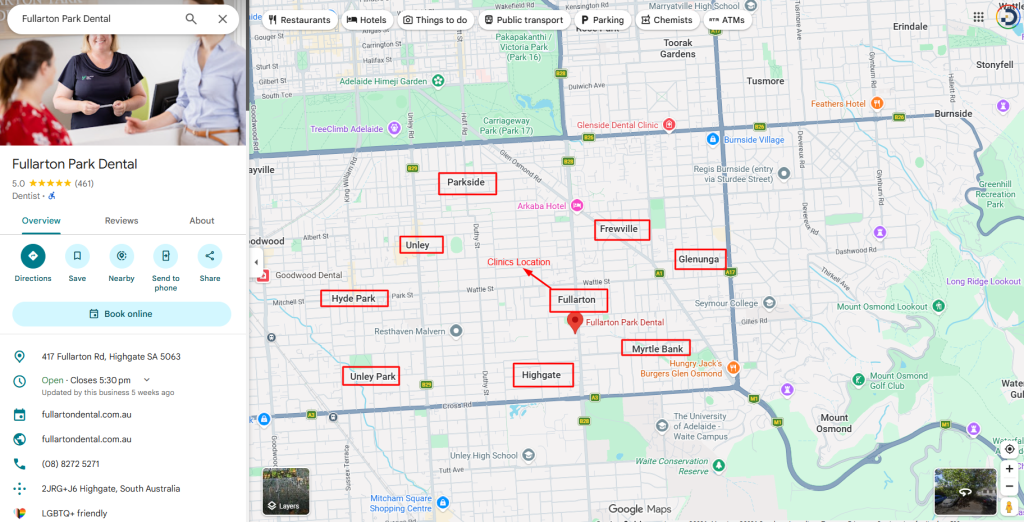
While city-level keywords attract significant search volume, many patients search using their suburb name. These hyperlocal searches typically have stronger booking intent and lower competition.
For practices serving multiple suburbs, dedicated suburb pages can significantly improve local rankings when each page includes unique, helpful content.
Example: https://www.fullartondental.com.au/
Primary Location: Fullarton SA (Keyword: dentist Fullarton Park)
Target nearby suburbs:
- Myrtle Bank
- Highgate
- Unley
- Frewville
- Glenunga
- Parkside
- Unley Park
- Hyde Park
Melbourne Examples
- Dentist Glenroy
- Dentist Coburg
- Dentist Brunswick
- Dentist Preston
- Dentist Craigieburn
- Dentist Reservoir
- Dentist Essendon
- Dentist Moonee Ponds
Sydney Examples
- Dentist Parramatta
- Dentist Chatswood
- Dentist Blacktown
- Dentist Liverpool
- Dentist Bondi
- Dentist Ryde
Brisbane Examples
- Dentist Chermside
- Dentist Sunnybank
- Dentist Indooroopilly
- Dentist Carindale
- Dentist Logan
Perth Examples
- Dentist Joondalup
- Dentist Fremantle
- Dentist Midland
- Dentist Morley
Adelaide Examples
- Dentist Glenelg
- Dentist Norwood
- Dentist Prospect
- Dentist Unley
- Dentist Mawson Lakes
Service + Suburb Keyword Templates
Creating suburb pages for every major treatment allows you to capture highly targeted searches.
| Keyword Template | Example |
| Dentist + Suburb | Dentist Glenroy |
| Emergency Dentist + Suburb | Emergency Dentist Glenroy |
| Family Dentist + Suburb | Family Dentist Glenroy |
| Cosmetic Dentist + Suburb | Cosmetic Dentist Glenroy |
| Children’s Dentist + Suburb | Children’s Dentist Glenroy |
| Dental Implants + Suburb | Dental Implants Glenroy |
| Invisalign + Suburb | Invisalign Glenroy |
| Teeth Whitening + Suburb | Teeth Whitening Glenroy |
| Root Canal + Suburb | Root Canal Glenroy |
| Wisdom Teeth Removal + Suburb | Wisdom Teeth Removal Glenroy |
Best Practice: Avoid creating duplicate suburb pages by simply replacing the suburb name. Each location page should include unique local content, nearby landmarks, frequently asked questions, directions, and links to relevant treatment pages.
Build Keyword Clusters Instead of Individual Pages
One of the biggest SEO mistakes dental practices make is creating separate pages for every keyword variation. Modern search engines understand semantic relationships, so it’s far more effective to build keyword clusters around a core topic.
Example Dental Keyword Clusters
| Primary Keyword | Supporting Keywords |
| Dental Implants | Implant dentist, All-on-4, missing tooth replacement, implant cost |
| Invisalign | Clear aligners, invisible braces, Invisalign cost, adult braces |
| Emergency Dentist | Broken tooth, chipped tooth, emergency extraction, toothache |
| Cosmetic Dentist | Veneers, teeth whitening, smile makeover, dental bonding |
| Children’s Dentist | Kids dentist, family dentist, first dental visit |
This approach helps a single, well-optimised page rank for dozens of related searches instead of targeting only one keyword.
Informational Dental Keywords
Not every visitor is ready to book immediately. Many begin by researching symptoms, treatment options, and costs. Informational content helps build trust while supporting your service pages.
| Keyword | Search Intent |
| How much do dental implants cost? | Informational |
| Is root canal painful? | Informational |
| How long does Invisalign take? | Informational |
| Are veneers worth it? | Informational |
| Why do gums bleed? | Informational |
| Can a cracked tooth be repaired? | Informational |
| How often should you visit the dentist? | Informational |
| How long does teeth whitening last? | Informational |
Aim to answer these questions clearly within the first few paragraphs of each article to improve your chances of appearing in featured snippets and AI-generated search results.
Transactional Dental Keywords
Transactional keywords indicate immediate intent to contact a clinic or book an appointment.
Examples include:
- Dentist near me
- Emergency dentist near me
- Dentist open today
- Same-day dentist
- Walk-in dentist
- Affordable dentist
- Book dentist appointment
- Emergency dental clinic
These keywords are best targeted with dedicated landing pages featuring strong calls to action, online booking functionality, and prominent contact details.
Cost-Related Dental Keywords
Pricing is one of the biggest considerations for patients comparing treatments.
Popular cost-related searches include:
| Keyword | Search Intent |
| Dental implant cost Australia | Informational |
| Invisalign cost | Informational |
| Veneers cost | Informational |
| Root canal cost | Informational |
| Wisdom teeth removal cost | Informational |
| Teeth whitening cost | Informational |
| Dental crown cost | Informational |
| Dentures cost Australia | Informational |
Rather than listing fixed prices that may change over time, explain the factors influencing treatment costs, available payment plans, and how personalised treatment plans are developed.
Long-Tail Dental Keywords Worth Targeting
Long-tail keywords typically have lower competition but attract highly qualified visitors because they reflect specific patient concerns.
Examples include:
- How much do dental implants cost in Australia?
- Emergency dentist open Sunday near me
- Best dentist for nervous patients
- How long do veneers last?
- Children’s dentist accepting new patients
- What is the cheapest way to replace missing teeth?
- Invisalign vs braces
- Can I eat after a root canal?
These keywords are ideal for blog posts, FAQs, and patient education resources that support your primary service pages.
Best Keywords for Dentist Google Ads
While SEO focuses on building long-term organic visibility, Google Ads allows dental practices to reach patients who are ready to book an appointment immediately. Running successful campaigns starts with choosing keywords that have strong commercial intent rather than simply chasing high search volumes.
A well-structured Google Ads account should separate keywords into tightly themed campaigns, making it easier to create relevant ad copy, improve Quality Scores, and maximise return on ad spend (ROAS).
Recommended Google Ads Campaign Structure
| Campaign | High-Intent Keywords |
| General Dentistry | Dentist near me, family dentist, dental clinic, general dentist |
| Emergency Dentistry | Emergency dentist, emergency dentist near me, emergency dental clinic, same-day dentist |
| Cosmetic Dentistry | Cosmetic dentist, veneers, teeth whitening, smile makeover |
| Dental Implants | Dental implants, implant dentist, All-on-4 dental implants, missing tooth replacement |
| Invisalign | Invisalign, Invisalign dentist, clear aligners, invisible braces |
| Children’s Dentistry | Children’s dentist, kids dentist, family dentist |
| Wisdom Teeth | Wisdom teeth removal, impacted wisdom teeth, wisdom tooth extraction |
Google Ads Best Practices for Dentists
To improve campaign performance:
- Target keywords with clear booking intent.
- Use location targeting to reach patients in your service area.
- Include suburb names in ad copy where appropriate.
- Create dedicated landing pages for each treatment.
- Use ad extensions such as call, location, and sitelinks.
- Add negative keywords to prevent irrelevant clicks (for example, “free”, “jobs”, “courses”, or “salary”).
Rather than sending every visitor to your homepage, direct users to a dedicated landing page that matches the search intent. Someone searching for “Emergency Dentist Melbourne” should land on your emergency dentistry page, not your general homepage.
SEO vs Google Ads: Which Strategy Is Better?
Many dental practice owners wonder whether they should invest in SEO or Google Ads. The reality is that both channels serve different purposes and deliver the best results when used together.
| SEO | Google Ads |
| Long-term investment | Immediate visibility |
| Builds sustainable organic traffic | Generates enquiries quickly |
| Strengthens trust and authority | Ideal for urgent or seasonal campaigns |
| Supports AI search visibility | Captures high-intent patients instantly |
| Continues generating traffic after ranking | Traffic stops when ad spend stops |
For example:
- A patient searching “How much do dental implants cost?” is more likely to discover your educational content through SEO.
- A patient searching “Emergency dentist near me” is more likely to click a Google Ad because they need treatment immediately.
Combining both strategies allows dental practices to capture patients at every stage of their decision-making journey.
Optimising Dental Content for AI Search
Search is evolving rapidly. Today, patients don’t just use Google—they also ask questions through Google AI Overviews, ChatGPT, Perplexity, Gemini, and voice assistants.
Rather than matching exact keywords, these platforms look for authoritative, well-structured, and trustworthy content that directly answers user questions.
How to Improve Visibility in AI-Powered Search
Build Topical Authority
Instead of publishing isolated blog posts, organise your content into topic clusters.
For example:
- Dental Implants
- Implant Costs
- Implant Procedure
- Recovery Timeline
- Implant vs Dentures
- Invisalign
- Invisalign Cost
- Invisalign vs Braces
- Invisalign for Adults
- Invisalign FAQs
This structure signals comprehensive expertise to both search engines and AI systems.
Answer Questions Clearly
AI search platforms favour content that provides concise, direct answers before expanding into detailed explanations.
For example:
Question: Is Invisalign better than braces?
Begin with a short answer, then explain:
- Advantages
- Disadvantages
- Cost differences
- Treatment duration
- Ideal candidates
Use Structured Headings
Organise your content using descriptive headings such as:
- What is Invisalign?
- Benefits of Invisalign
- How Much Does Invisalign Cost?
- Frequently Asked Questions
Clear structure helps AI systems identify relevant information quickly.
Strengthen Internal Linking
Link related treatment pages, blog posts, and location pages to create a connected content ecosystem.
Demonstrate Trust and Expertise
Because dental websites fall under Google’s Your Money or Your Life (YMYL) guidelines, every article should demonstrate expertise and credibility.
Include:
- Author information
- Dentist credentials
- Clinic details
- Updated content
- References where appropriate
- Accurate, patient-focused information
These trust signals improve both search visibility and patient confidence.
Best Keyword Research Tools for Dentists
Effective keyword research combines multiple tools rather than relying on a single data source.
Google Keyword Planner
Ideal for:
- Keyword ideas
- Google Ads planning
- Search volume estimates
Google Search Console
Perfect for identifying:
- Existing ranking keywords
- Pages gaining impressions
- Click-through rate opportunities
- Low-hanging keyword improvements
Google Trends
Useful for identifying:
- Seasonal trends
- Emerging topics
- Regional search interest
Ahrefs
Excellent for:
- Keyword difficulty
- Competitor analysis
- Backlink research
- Content gap analysis
Semrush
Useful for:
- Keyword research
- Position tracking
- Competitor insights
- Site audits
SE Ranking
A cost-effective option for:
- Daily keyword tracking
- Local SEO monitoring
- Competitor rankings
- Website audits
Google Autocomplete & People Also Ask
These free resources reveal real questions patients are asking and can inspire blog topics that align with search intent.
How to Choose the Right Dental Keywords
Not every keyword deserves equal attention. The best opportunities balance search demand with commercial value and realistic competition.
When evaluating keywords, consider:
Search Intent
Does the keyword indicate that someone is researching or ready to book?
Search Volume
Higher search volume isn’t always better. Lower-volume, high-intent keywords often generate more enquiries.
Competition
Newer dental websites should initially target long-tail and suburb-specific keywords before competing for broad national terms.
Local Relevance
Focus on the suburbs and cities where your practice actually operates.
Commercial Value
Prioritise treatments that align with your business goals, such as implants, Invisalign, cosmetic dentistry, and emergency care.
A practical strategy is to group keywords into three priority levels:
| Priority | Examples |
| High | Emergency dentist, dental implants, Invisalign |
| Medium | Family dentist, children’s dentist, cosmetic dentist |
| Supporting | Cost guides, FAQs, treatment comparisons, oral health blogs |
Common Dental SEO Mistakes to Avoid
Even a well-designed dental website can struggle to rank if it overlooks the fundamentals of modern SEO. Here are some of the most common mistakes Australian dental practices should avoid.
- Targeting only broad keywords such as “dentist” instead of focusing on treatment-specific, local, and long-tail keywords that better match patient intent.
- Publishing thin treatment pages with limited information rather than creating comprehensive content that answers common patient questions and explains procedures in detail.
- Creating duplicate suburb pages by simply changing the suburb name instead of developing unique, location-specific content for each area you serve.
- Ignoring local business listings by failing to optimise and regularly update your Google Business Profile, Bing Places, and Apple Business Connect (Apple Maps) profiles.
- Neglecting internal linking between treatment pages, blog posts, FAQs, and location pages, making it harder for both users and search engines to navigate your website.
- Failing to answer common patient questions, reducing your chances of appearing in Featured Snippets, Google AI Overviews, and other AI-powered search experiences.
- Missing structured data (Schema Markup) such as FAQ, Local Business, Organization, Medical Business, Review, and Breadcrumb schema that help search engines better understand your website.
- Publishing outdated content without reviewing treatment information, pricing guidance, or dental best practices to keep your content accurate and relevant.
- Overlooking technical SEO issues such as slow page speed, poor Core Web Vitals, broken links, and a poor mobile experience that can negatively impact rankings.
- Ignoring AI search optimisation by focusing only on traditional keyword rankings instead of building topical authority and well-structured, question-based content.
- Making misleading claims or ignoring AHPRA advertising guidelines, including guarantees, exaggerated treatment outcomes, or unsupported comparisons that may affect compliance and patient trust.
- Neglecting online reviews and reputation management, as genuine patient reviews are an important ranking factor for local SEO and influence potential patients when choosing a dental practice.
Avoiding these common mistakes creates a stronger foundation for long-term SEO success, helping your dental practice improve search visibility, build patient trust, and generate more qualified appointment enquiries.
Frequently Asked Questions
What are the best SEO keywords for dentists?
Some of the most valuable keywords include dentist near me, emergency dentist, family dentist, dental implants, Invisalign, and location-based keywords such as dentist Melbourne or dentist Parramatta.
Should dentists target suburb keywords?
Yes. Patients frequently search using suburb names, making suburb-specific landing pages one of the most effective local SEO strategies.
Are informational keywords worth targeting?
Absolutely. Educational content builds trust, supports topical authority, and helps your website appear in Google AI Overviews, featured snippets, and AI-powered search results.
Which keywords work best for Google Ads?
High-intent treatment keywords such as emergency dentist, dental implants, Invisalign, cosmetic dentist, and wisdom teeth removal typically deliver the strongest return on investment.
How many keywords should one page target?
Rather than targeting a single keyword, focus on one primary keyword supported by several closely related secondary keywords that share the same search intent.
How long does dental SEO take?
While results vary depending on your competition and website authority, many practices begin seeing measurable improvements within 3–6 months, with stronger long-term growth achieved through consistent content publishing and local SEO.
Can AI search replace traditional SEO?
No. AI-powered search complements traditional SEO rather than replacing it. The same principles, high-quality content, topical authority, and trustworthy information, remain essential for earning visibility across Google Search, AI Overviews, ChatGPT, Gemini, and Perplexity.
Final Thoughts
Dental keyword research is no longer just about finding the highest-volume search terms. Success in 2026 requires understanding how patients search, what they expect to find, and how search engines evaluate trustworthy healthcare content.
Rather than trying to rank for every keyword, focus on building a comprehensive content strategy around:
- Treatment-specific service pages
- Location and suburb landing pages
- Educational blogs that answer common patient questions
- High-intent transactional pages
- Cost guides and comparison articles
- Strong internal linking and topical clusters
This approach not only improves traditional search rankings but also increases your chances of being cited in Google AI Overviews and other AI-powered search experiences.
Whether you’re managing SEO in-house or working with an agency, remember that sustainable growth comes from quality, relevance, and consistency, not keyword stuffing.
If you’re looking to accelerate your dental practice’s online growth, our team at Digi Marketing Work can help you develop a data-driven SEO strategy tailored to Australian dental practices. From comprehensive keyword research and AI SEO Services in Melbourne to Website Development, Local SEO, Google Ads, and content marketing, we help clinics attract more qualified patients and build long-term online visibility.
Before choosing an SEO partner, we also recommend reading our guide on Questions to Ask an SEO Agency Before Hiring to ensure you’re selecting a team with the expertise to navigate the unique challenges of dental marketing.
Finally, if you’d like to see what’s possible, explore our Melbourne Dental Clinic Case Study, where a targeted SEO strategy helped increase qualified website leads by 60% in just six months—demonstrating the impact of combining keyword research, local SEO, and patient-focused content into a single, cohesive digital marketing strategy.