SEO in Australia costs $1,000 to $5,000 per month for most small and mid-sized businesses in 2026, based on published pricing across multiple Australian agencies. Under $1,500 per month buys entry-level SEO for low-competition local markets; $1,500 to $3,500 covers growth-tier SEO for most small businesses; and $3,500 to $7,500 or more targets competitive, saturated markets. Hourly consulting runs $150 to $300 per hour, and project-based work such as audits or migrations ranges from $1,500 to $10,000.
If you have ever asked an agency how much is SEO and walked away with three different quotes, you are not alone: cost depends on your website’s size, industry competition, local versus national visibility, and how much technical, content and link building work is needed. This guide by Digi Marketing Work breaks down pricing for SEO services in Australia for 2026, including monthly retainers, hourly rates, seo packages australia by business type, what a genuine package should include, and how to choose the right SEO partner.
How Much Does SEO Cost in Australia in 2026? (Quick Answer)
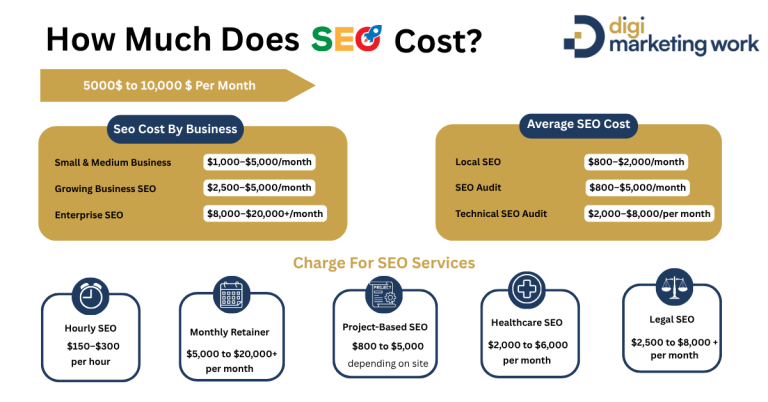
SEO in Australia typically costs between $1,000 and $5,000 per month for small and medium businesses, $2,500 to $8,000+ per month for growing and competitive businesses, and $8,000 to $ 20,000+ per month for enterprise and highly competitive ecommerce campaigns. Hourly SEO consulting runs from $150 to $300 per hour, and one-off projects such as audits or migrations generally range from $800 to $10,000, depending on scope.
There is no single standard cost for SEO services because every business needs a different combination of technical work, content, and link building. The table below gives a realistic snapshot of what Australian businesses pay in 2026.
| SEO Type | Average Cost |
| Local SEO | $800–$2,000/month |
| Small Business SEO | $1,000–$2,500/month |
| Growing Business SEO | $2,500–$5,000/month |
| E-commerce SEO | $3,000–$10,000+/month |
| Enterprise SEO | $8,000–$20,000+/month |
| SEO Audit | $800–$5,000 |
| Technical SEO Audit | $2,000–$8,000 |
| Hourly SEO | $150–$300/hr |
These figures line up closely with what Australian agencies are publishing across the market in 2026, and they reflect genuine deliverables, not entry-level packages designed purely to win a quote comparison.
What Determines the Cost of SEO Services?
SEO pricing is not arbitrary. Agencies price campaigns based on how much work is genuinely required to get a website to rank, and that varies widely depending on the following factors.
Website Size
A five-page business website needs far less technical and content work than a 5,000-product ecommerce store or a multi-location franchise site. More pages mean more crawling, indexing and internal linking considerations, which increases the hours required each month.
Industry Competition
Ranking a suburban dog groomer is a very different job from ranking a personal injury lawyer or a mortgage broker in a capital city. Highly competitive industries such as legal, finance, insurance, and healthcare require greater content depth, more authoritative backlinks, and more time to see results, all of which increase costs.
Local vs National SEO
Local SEO targeting a single city or region generally costs less than national SEO, because the pool of competing businesses and keywords is smaller. National and multi-location campaigns require broader keyword coverage, more content, and stronger domain-wide authority.
E-commerce Complexity
E-commerce SEO adds layers that standard SEO does not need to deal with: product and category page optimisation, faceted navigation, duplicate content risks, Merchant Centre feed alignment, and schema across thousands of SKUs. The bigger and more complex the store, the higher the price.
Existing Website Health
A well-built, healthy website needs lighter technical intervention. An older or poorly maintained site with broken links, duplicate content, slow load times or indexing problems needs a heavier (and more expensive) technical clean-up before growth work can even begin.
Technical SEO Issues
Core Web Vitals failures, wasted crawl budget, canonicalisation errors, and poor site architecture all add hours to a campaign. Technical debt is one of the most common reasons an initial quote increases once an agency actually audits the site.
Content Requirements
The volume and quality of content needed to compete directly affect price. A niche local business might need a handful of well-optimised pages, while a competitive national brand may need dozens of blog posts, landing pages and content clusters every quarter.
Link Building
Backlinks remain one of Google’s strongest ranking signals, and quality link building, through digital PR, editorial outreach and guest content, takes genuine time and relationships to execute. Agencies that promise large volumes of cheap links are typically using low-quality tactics that risk future penalties.
AI Search Optimisation
Optimising for Google’s AI Overviews, ChatGPT, Gemini and Perplexity has become part of modern SEO packages, adding structured data work, clearer content formatting and citation tracking that did not exist in traditional SEO scopes a few years ago.
GEO & AEO Optimisation
Generative Engine Optimisation (GEO) and Answer Engine Optimisation (AEO) focus specifically on being cited inside AI-generated answers, rather than simply ranking in the traditional ten blue links. This is an emerging cost factor as more agencies build it into standard packages.
Brand Authority
Businesses with little to no existing online authority typically need more investment upfront to establish credibility with Google, compared with an established brand that already has a strong backlink profile and reputation.
Conversion Optimisation
Some SEO packages include conversion rate optimisation, ensuring the traffic SEO generates actually converts into enquiries and sales. This adds a strategic layer beyond rankings and traffic alone, and typically sits at the higher end of package pricing.
Which SEO Pricing Model Is Best for Your Business?
Not every business should be buying the same type of SEO engagement. Choosing the right pricing model matters just as much as choosing the right agency.
Monthly Retainer
How it works: You pay a fixed monthly fee for ongoing SEO work: technical maintenance, content, link building and reporting, delivered consistently over time.
Pros:
- Predictable, budgetable monthly cost
- Supports the compounding nature of SEO, since rankings build over months, not days
- An ongoing relationship means the agency understands your business deeply over time
- Easier to adjust the scope as your business grows
Cons:
- Requires a longer-term commitment to see meaningful results
- Value can be harder to judge in the first few months
- Poor-quality agencies can coast on a retainer without clear deliverables
Average pricing: $1,000 to $5,000 per month for most small and medium Australian businesses, scaling to $8,000 to $20,000+ per month for enterprise and highly competitive campaigns.
Best for: Businesses seeking sustainable, long-term organic growth rather than a quick fix; the majority of small to medium Australian businesses fall into this category.
Hourly SEO
Average pricing: $150 to $300 per hour, depending on the consultant’s seniority and specialisation.
When suitable: Hourly pricing works well for short, defined pieces of work, such as a technical deep dive, a training session for an in-house team, or troubleshooting a specific ranking drop. It is generally not cost-effective for ongoing, full-scope SEO, since the hours required each month for meaningful growth quickly exceed the cost of a retainer.
Project-Based SEO
Project pricing suits businesses with a specific, time-boxed need rather than ongoing management.
- SEO Audit: A comprehensive review of technical health, content and backlink profile, typically $800 to $5,000 depending on site size.
- Migration: Managing SEO through a domain change, platform move or redesign to protect rankings, typically $3,000 to $10,000 depending on site complexity.
- Penalty Recovery: Diagnosing and fixing a Google penalty or algorithmic devaluation; pricing varies significantly based on the severity and cause of the drop.
- Website Launch: SEO foundations built into a new site build, ensuring the site launches with correct technical structure, on-page optimisation and tracking in place.
Performance-Based SEO
How it works: Payment is tied to results, such as ranking positions, traffic growth, or leads generated, and is usually structured as a lower base fee plus performance bonuses.
Pros:
- Aligns the agency’s incentives with your outcomes
- Can lower upfront financial risk
Cons:
- Difficult to structure fairly, since rankings depend on many factors outside any agency’s direct control (including Google’s algorithm itself)
- Can encourage short-term or risky tactics, chasing quick wins rather than sustainable growth
- Rarely accounts for the compounding, long-term nature of genuine SEO value
Why most reputable agencies avoid guarantees: Google’s algorithm is not something any agency controls, and no legitimate SEO agency guarantees specific rankings. Performance-based pricing that promises “page one in 30 days” is one of the clearest red flags in the industry; it typically signals either black-hat tactics or a business model built on churn rather than results.
How Much Do SEO Packages Cost for Different Types of Businesses?
Generic SEO packages rarely fit real businesses well. Here is what pricing and deliverables genuinely look like across common Australian business types.
Small Business SEO Packages
Pricing: $1,000 to $2,500 per month.
Deliverables typically include: a technical audit and ongoing fixes; on-page optimisation of key pages; monthly content (usually one to four pieces); foundational local SEO, if relevant; basic link building; and monthly reporting focused on traffic, rankings, and enquiries rather than vanity metrics.
Local SEO Packages
Pricing: $800 to $2,000 per month.
Local SEO packages centre on the elements that drive visibility in your specific service area:
- Google Business Profile: ongoing optimisation, posting, Q&A management and photo strategy
- Location pages: geo-targeted pages built for each suburb or service area you cover
- Reviews: a structured approach to generating and responding to Google reviews
- Local citations: ensuring your business name, address and phone number are accurate and consistent across Australian directories
For a full breakdown of why this matters so much for Australian businesses, see our guide to the benefits of local SEO.
Healthcare SEO Pricing
Pricing: $2,000 to $6,000 per month.
Healthcare SEO sits above general small business pricing because of the compliance and trust requirements involved:
- AHPRA compliance: content must be written and reviewed with Australian Health Practitioner Regulation Agency advertising guidelines in mind, particularly around therapeutic claims and testimonials
- Medical content: accurate, well-researched content covering conditions, treatments and procedures, ideally reviewed by a qualified practitioner
- Trust signals: practitioner bios, credentials, and genuine patient reviews that build the E-E-A-T (Experience, Expertise, Authoritativeness, Trustworthiness) signals Google weighs heavily for health-related content
Legal SEO Pricing
Pricing: $2,500 to $8,000+ per month.
Legal SEO is consistently one of the most expensive categories, driven by:
- Competition: practice areas like personal injury, family law and criminal defence are among the most fought-over keywords in Australian search
- Authority: law firms need substantial backlink authority and content depth to compete, particularly in capital cities
- Content requirements: detailed, accurate legal content that demonstrates genuine expertise, since generic or thin content struggles to rank in this space
Tradies SEO Pricing
Pricing: $800 to $2,500 per month.
Tradie SEO (plumbers, electricians, roofers, HVAC and similar) tends to sit at the more affordable end, since campaigns are usually local rather than national. The priority is Google Business Profile optimisation, local landing pages, and review generation, since most tradie searches are high-intent, “near me” style queries where speed of contact matters more than long-form content.
SaaS SEO Pricing
Pricing: $3,000 to $10,000+ per month.
SaaS SEO requires alignment with the product-led growth funnel: comparison and alternative pages targeting high-intent searches, programmatic content built to scale without sacrificing quality, and content mapped to trial or demo conversion rather than just traffic volume.
Enterprise SEO Pricing
Pricing: $8,000 to $20,000 or more per month.
Enterprise SEO involves governance across large teams and complex site architecture, international SEO and, where relevant, hreflang implementation, automation to manage sites at scale, and close alignment with broader paid and brand strategy. At this level, SEO becomes less about individual tactics and more about coordinating a large content and technical operation.
E-commerce SEO Packages
Pricing: $3,000 to $10,000 or more per month.
E-commerce is one of the most important and highest-value categories in SEO pricing, since organic visibility directly drives revenue rather than just enquiries. E-commerce SEO packages typically cover:
- Platform-specific optimisation: technical and structural work tailored to Shopify, WooCommerce or Magento, since each platform has its own indexing quirks, URL structures and plugin ecosystems
- Product pages: unique, optimised titles, descriptions and schema for individual products rather than manufacturer copy duplicated across the web
- Category pages: building topical authority and internal linking structure around category-level pages, which often carry the most commercial search volume
- Technical SEO: managing faceted navigation, pagination, duplicate content risks from filters and variants, and site speed at scale
- Merchant Centre: ensuring your Google Merchant Centre feed is aligned with your on-site schema and product data for consistent visibility across organic and Shopping results
- Schema: Product, Offer, Review and AggregateRating schema implemented correctly across the catalogue to improve rich result eligibility
What Should Be Included in an SEO Package?
Not all SEO packages are created equal, and the difference often comes down to what is actually included versus what is upsold later. Here is a realistic comparison across common package tiers.
| Deliverable | Starter | Growth | Premium | Enterprise |
| Technical SEO | Basic fixes | Ongoing monitoring | Comprehensive audits | Full governance & automation |
| Keyword Research | Core terms | Expanded intent mapping | Full competitive gap analysis | Multi-market keyword strategy |
| Content | 1–2 pages/month | 2–4 pieces/month | 4–8 pieces/month | Content team & editorial calendar |
| Blog Writing | Limited | Regular | Weekly | Multiple weekly across topics |
| Internal Linking | Basic | Structured | Strategic silo building | Site-wide architecture |
| Schema | Basic markup | Extended markup | Full schema library | Custom schema at scale |
| Link Building | Minimal | Monthly outreach | Digital PR campaigns | Ongoing PR & authority building |
| Reporting | Monthly summary | Monthly + call | Detailed monthly + strategy call | Custom dashboards & governance reporting |
| Conversion Tracking | Basic | Standard | Advanced attribution | Full multi-channel attribution |
| AI Search Optimisation | Not included | Foundational | Structured for AI Overviews | Full AI citation tracking |
| AI Overview Optimisation | Not included | Basic | FAQ & structured content | Ongoing optimisation & monitoring |
| Entity SEO | Not included | Basic | Established | Advanced entity building |
| Knowledge Graph | Not included | Not included | Basic optimisation | Active management |
| Digital PR | Not included | Occasional | Regular campaigns | Ongoing strategic campaigns |
If a package you are quoted is missing several of these rows entirely, ask directly what is included and what costs extra before signing. Vague scopes are among the most common causes of SEO disappointment, and knowing the questions to ask an SEO agency up front before hiring can save months of wasted spend.
How Much Does an SEO Audit Cost?
An SEO audit typically costs between $800 and $5,000, depending on the website’s size and the depth of the audit.
Basic Audit
Pricing: $800 to $2,000. Covers core on-page elements, indexing status, obvious technical issues, and a high-level snapshot of keywords and competitors. Suited to smaller websites needing a general health check.
Technical Audit
Pricing: $2,000 to $8,000. A deeper dive into Core Web Vitals, crawl efficiency, site architecture, schema implementation, redirects and canonical issues. This is the audit most agencies recommend before committing to an ongoing retainer, since it reveals exactly how much technical work is genuinely needed.
Enterprise Audit
Pricing: $5,000 to $15,000+. Covers large, complex sites with thousands of pages, multiple subdomains or international variants, requiring significant crawling, data analysis and stakeholder coordination.
E-commerce Audit
Pricing: $2,000 to $8,000. Focuses specifically on product and category page structure, duplicate content from filters and variants, Merchant Centre alignment, and schema across the catalogue.
How Much Does Technical SEO Cost?
Technical SEO is the foundation on which everything else is built, and pricing depends heavily on the amount of existing technical debt a site carries.
| Technical SEO Task | Typical Cost |
| Site speed optimisation | $500–$3,000 |
| Core Web Vitals fixes | $1,000–$5,000 |
| Schema implementation | $500–$3,000 |
| Indexing & crawl optimisation | $1,000–$4,000 |
| Canonical & redirect clean-up | $500–$2,500 |
| Full site migration | $3,000–$10,000+ |
What’s typically involved:
- Site speed and Core Web Vitals: improving Largest Contentful Paint, Cumulative Layout Shift and Interaction to Next Paint, since these directly affect both rankings and user experience
- Schema: structured data implementation that helps Google, and increasingly AI systems, understand and display your content accurately
- Indexing and crawl optimisation: ensuring the right pages are indexed, and the crawl budget is not wasted on low-value or duplicate URLs
- Canonical and redirects: cleaning up duplicate content issues and ensuring old URLs correctly pass authority to new ones
- Migration: one of the highest-risk, highest-cost technical SEO projects, since a poorly managed domain or platform migration can wipe out years of accumulated rankings almost overnight
How Much Does Off-Page SEO Cost?
Off-page SEO, the work that builds your website’s authority through external signals, typically costs between $1,000 and $6,000 per month as part of an ongoing campaign, or from $4,000 per standalone digital PR campaign.
What’s included:
- Citations: consistent business listings across Australian directories, particularly important for local SEO
- Digital PR: creating data-driven stories, original research or tools designed to earn media coverage and high-quality backlinks
- Authority links: backlinks from genuinely relevant, reputable websites in your industry
- Editorial backlinks: natural placements within existing articles on publisher sites, earned through outreach rather than paid placement
- HARO alternatives: platforms and outreach methods connecting businesses with journalists seeking expert commentary, now that the original HARO service has changed hands and format
- Brand mentions: unlinked mentions of your business name across the web, which increasingly contribute to how both Google and AI systems assess your authority and legitimacy
Be wary of any agency promising hundreds of backlinks per month for a low fixed fee. Genuine editorial links take real outreach and relationships to earn, and high-volume, low-cost link packages are one of the clearest signs of risky, low-quality link building that can trigger a Google penalty later.
Why Do SEO Prices Vary So Much Between Agencies?
Two agencies can quote wildly different prices for what looks like the same scope on paper, because the actual work behind the price varies enormously.
- Experience: a senior strategist with a decade of results commands a different rate than a junior account manager following a template playbook
- Team structure: agencies with dedicated technical, content and link building specialists typically charge more than generalists handling everything themselves, but usually deliver stronger results
- Strategy: a genuinely researched, competitor-informed strategy costs more to build than a generic package applied to every client, regardless of industry
- Content quality: original, well-researched content written by people who understand the industry costs significantly more than templated or AI-generated content with no editorial oversight
- Reporting: agencies that build custom dashboards connecting SEO activity to leads and revenue invest more in reporting infrastructure than those sending a generic monthly PDF
- AI tools: access to premium SEO platforms, AI-assisted research tools and proprietary tracking systems adds to an agency’s cost base, which is reflected in pricing
- Technical expertise: genuine technical SEO skill, particularly for larger or more complex sites, is a specialised and scarcer skill set than general on-page optimisation
- Transparency: agencies that are upfront about scope, timelines and limitations tend to price more consistently than those relying on vague promises to win business
How Long Does SEO Take Before You See Results?
SEO is a compounding investment, not an instant switch. Here is a realistic timeline for most Australian businesses.
- 30 days: Technical audit complete, foundational fixes underway, initial on-page optimisation applied. No meaningful ranking movement expected yet.
- 60 days: Early indexing improvements are visible; low-competition, long-tail keywords may begin to show early movement.
- 90 days: Organic traffic growth becomes noticeable for lower-competition terms; local SEO campaigns in particular often show measurable improvement by this point.
- 6 months: Meaningful ranking gains across a broader set of target keywords; leads and enquiries from organic search become trackable and measurable.
- 12 months: Competitive keyword gains become achievable; domain authority has built enough to support more ambitious content and link targets.
- 24 months: A mature, compounding organic presence; cost per acquisition from organic search is typically well below paid channels, and rankings for genuinely competitive terms are within reach.
Local SEO in lower-competition markets often moves faster than this timeline, sometimes showing results within two to three months, while highly competitive national or ecommerce campaigns can realistically sit at the longer end.
What ROI Can You Expect From SEO?
SEO’s real value shows up in reduced customer acquisition cost (CAC) over time, not just in traffic numbers. Understanding this properly means looking beyond rankings to the commercial outcomes SEO actually produces.
Key metrics to track:
- Customer Acquisition Cost (CAC): total SEO spend divided by the number of new customers generated from organic search; this typically falls over time as rankings compound
- Lead value: the average revenue generated per enquiry or lead, which varies enormously by industry (a single legal or mortgage broker lead is worth far more than a single retail sale)
- Lifetime value (LTV): the total revenue a customer generates over their full relationship with your business, which matters enormously when judging whether an upfront SEO investment is worthwhile
- Organic traffic growth: the raw increase in non-paid visits over time, tracked in Google Analytics 4
- Revenue attribution: connecting specific organic landing pages and keywords to actual sales or enquiries, not just sessions
A simple ROI example: a business spending $2,500 per month on SEO ($30,000 per year) that generates 50 additional qualified leads per month by month eight, converting at 20% with an average customer value of $2,000, is generating roughly $20,000 in monthly revenue from that traffic by that point, a return that continues to build well beyond the initial investment period, since organic rankings do not disappear the moment you stop paying, unlike paid advertising.
SEO vs Google Ads: Which Delivers Better Long-Term Value?
This is one of the most common questions Australian business owners ask, and the honest answer depends on your timeline and goals.
| Factor | SEO | Google Ads |
| Traffic | Organic, earned over time | Paid, immediate |
| Time to results | 3 to 12 months | Immediate |
| Cost structure | Ongoing investment in content and optimisation | Pay per click |
| Lead quality | Often higher for informational and research-stage searches | Strong for high-intent commercial searches |
| Scalability | Gradual and compounding | Rapid and controllable |
| Long-term value | High: continues after investment pauses | Stops when the budget ends |
| Brand trust | Higher: users generally trust organic results more | Moderate: users recognise paid labels |
| AI visibility | Increasingly rewarded through citations in AI Overviews | Largely unaffected, ads remain distinctly labelled |
In short, SEO builds a compounding, long-term asset, while Google Ads delivers immediate, controllable visibility that disappears the moment spending stops. Most Australian small businesses get the best results running both together: Google Ads for immediate leads while SEO builds toward a lower long-term cost per acquisition. If you’re evaluating which channel is right for your business, explore our Google Ads Melbourne services to see how paid search can complement your long-term SEO strategy, or learn more about our SEO Services Melbourne for ongoing organic growth. We also cover this comparison in more depth in our guide on SEO vs Google Ads for small businesses.
Is AI Changing SEO Pricing in 2026?
Yes, and it is one of the biggest shifts in SEO pricing in recent years. AI Overviews, ChatGPT, Gemini and Perplexity are increasingly answering user queries directly, sometimes without the searcher ever clicking through to a website. This has added genuinely new work and genuinely new cost to modern SEO packages.
If your goal is to increase brand visibility across both traditional and AI-powered search, explore our AI SEO Services to learn how modern optimisation strategies can help your business earn citations and recommendations in AI-generated answers.
What this means in practice:
- AI Overviews: Google’s AI-generated summaries now appear across a large share of search queries, and being cited within them is becoming a visibility goal in its own right, separate from a traditional ranking position
- ChatGPT, Gemini and Perplexity: these platforms are increasingly used as discovery tools, and appearing as a cited source within their answers requires structured, clearly written, factual content
- Entity SEO: helping Google and AI systems understand your business as a real, verified entity, with consistent information across your website, citations and structured data
- GEO (Generative Engine Optimisation): optimising specifically to be referenced within AI-generated answers, which rewards clearly structured, well-sourced content over keyword density
- AEO (Answer Engine Optimisation): structuring content to directly and concisely answer specific questions, the format most likely to be pulled into featured snippets, voice search and AI Overviews
- Structured data: schema markup that makes your content machine-readable, increasingly important as more of the “reading” is now done by AI systems rather than humans scrolling a results page
- Brand mentions: unlinked references to your business are increasingly treated as authority signals by AI platforms, not just backlinks
This is why modern SEO packages increasingly include AI search optimisation alongside traditional Google SEO rather than as a separate add-on. A campaign that targets only the traditional ten blue links is, in effect, targeting only half of where visibility now occurs.
How Can You Choose the Right SEO Agency in Australia?
Choosing an SEO partner is one of the more consequential marketing decisions a business makes, since a poor choice can cost months of lost growth, or in the worst cases, a Google penalty that takes years to recover from.
Checklist for evaluating an agency:
- Do they provide clear, documented case studies with real traffic and lead data, not just vague claims?
- Is their reporting transparent, connecting activity to leads and revenue rather than rankings alone?
- Can they explain their link-building methods plainly, without hesitation or vague “high authority link” language?
- Do they have a clear, structured plan for the first 90 days?
- Do they follow Google’s guidelines and EEAT principles rather than promising guaranteed rankings?
- Do you retain full ownership and access to your website, Google Analytics, Search Console and all content created?
- Can they speak to how they approach AI search optimisation, not just traditional rankings?
Red flags to watch for: guaranteed page-one rankings within 30 days, refusal to share client references, vague or evasive answers about backlink sources, and generic monthly reports with no clear connection to business outcomes.
Before signing with any agency, it is worth working through a proper list of questions covering their process, reporting, pricing, and contract terms.
Final Thoughts
SEO pricing in Australia in 2026 reflects genuine work: technical health, content depth, link building, and increasingly, AI search visibility. The businesses that get the best return are not the ones chasing the cheapest quote, but the ones matching their investment to their competition level, growth goals and timeline.
For most small and medium Australian businesses, a monthly retainer between $1,000 and $5,000 delivers meaningful, compounding growth over 6 to 12 months. Larger, more competitive or e-commerce businesses should expect to invest more, but the long-term payoff, a lower cost per lead that continues to improve over time, is what makes SEO one of the most durable marketing investments available.
As a digital marketing agency in Melbourne, Digi Marketing Work builds transparent, results-driven SEO strategies tailored to your industry, budget and growth goals, covering technical SEO, content, local SEO, link building and AI search optimisation under one clear, honest reporting structure. Get in touch for a free SEO audit and a straightforward conversation about what your business genuinely needs.
Frequently Asked Questions
What is the average cost of SEO services?
Most small and medium Australian businesses pay between $1,000 and $5,000 per month for SEO, with pricing increasing for more competitive industries, larger websites, and ecommerce stores.
How much does SEO cost per month?
Monthly SEO retainers in Australia typically range from $800 for basic local packages to $20,000 or more for enterprise campaigns, with most small businesses sitting between $1,000 and $2,500 per month.
What is technical SEO?
Technical SEO covers the infrastructure of your website, including page speed, Core Web Vitals, crawlability, indexing, schema markup and site architecture, everything that affects how well Google and AI systems can read and understand your site.
Is SEO worth paying for?
For most businesses with a medium to long-term growth outlook, yes. SEO builds a compounding traffic asset that continues generating leads even after you stop actively investing, unlike paid advertising, which stops the moment the spend ends.
How long should I pay for SEO?
SEO is generally a 12-month-or-longer commitment for meaningful, compounding results, though local and lower-competition campaigns can show measurable traction within 3 to 6 months.
What should an SEO package include?
A genuine SEO package should include technical SEO, keyword research, content creation, internal linking, schema markup, link building, transparent reporting, conversion tracking, and increasingly, AI search optimisation.
What is included in monthly SEO services?
Most monthly SEO services include ongoing technical monitoring and fixes, new and optimised content, link building or digital PR activity, and a monthly report that connects the work to traffic, rankings, and leads.
How much should a small business spend on SEO?
Small businesses in Australia typically spend between $1,000 and $2,500 per month, which covers foundational technical work, regular content, basic link building and local SEO where relevant.