
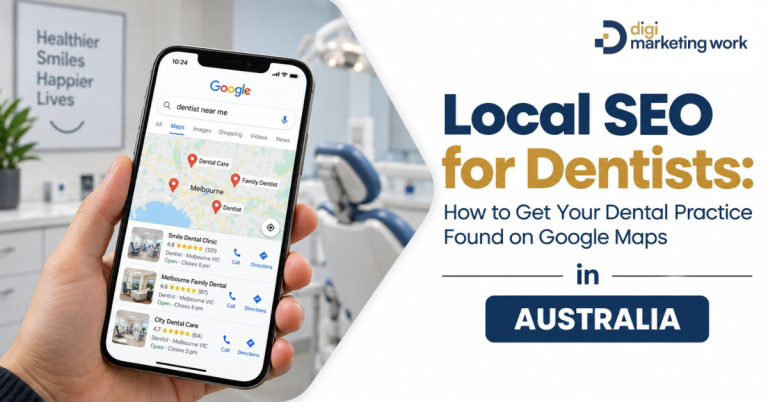
Local SEO for dentists is the process of improving a dental practice’s visibility in Google Maps, the Local Pack and organic search results for location-specific and treatment-specific searches such as “dentist near me,” “dentist Melbourne,” “emergency dentist Melbourne,” “dentist Richmond”, and “dental implants Melbourne.” It combines Google Business Profile optimisation, local website SEO, reviews, citations, local authority, technical SEO and location-relevant content.
For Melbourne dentists, the goal isn’t simply to rank for “dentist.” It’s to become the relevant, trusted and geographically appropriate practice for the searches that can actually lead to appointments. Google states that local rankings are primarily influenced by relevance, distance and prominence, and these three concepts form the foundation of everything below.
Local SEO Checklist for Dentists in Melbourne
As a local SEO specialist, we recommend the following checklist for dentists in Melbourne:
Google Business Profile
- Correct primary category
- Complete business information
- Accurate hours
- Services
- Appointment URL
- High-quality images
- Review monitoring
Website
- Mobile-friendly
- Fast
- Treatment pages
- Location relevance
- Internal links
- LocalBusiness/Dentist structured data where appropriate
- Indexable pages
Local authority
- NAP audit
- Relevant citations
- Local backlinks
- Professional mentions
Content
- Commercial treatment content
- Local content
- Educational content
- FAQs
- Unique suburb content where justified
AI/search readiness
- Clear entity information
- Consistent business facts
- Crawlable content
- Structured information
- Direct answers to patient questions
Measurement
- Search Console
- Analytics
- GBP performance
- Maps visibility
- Calls
- Booking enquiries
- New-patient conversions
What Is Local SEO for Dentists and How Does It Work?
Local SEO for Dentists Connects Three Types of Google Visibility
- Hyperlocal search: “dentist near me,” “dentist open now,” “emergency dentist near me”
- Local search: “dentist Melbourne,” “dentist Richmond,” “cosmetic dentist South Yarra”
- Local organic search: Service + location searches that lead to specific website pages
The Three Google Local Ranking Factors Dentists Need to Understand
Google’s own local ranking framework is built around three factors:
- Relevance: How closely the practice matches what the searcher is looking for.
- Distance: How close the practice is to the searcher’s location, or the location implied in the search.
- Prominence: How established and recognised the practice is, both online and offline.
Every tactic in this guide, from Google Business Profile setup to reviews and content, ultimately feeds into one of these three factors. As a digital marketing agency in Australia, Digi Marketing Work provides guidance to dental agencies for local SEO services.
Why Ranking for “dentist” is Different From Ranking for “dental implants Melbourne”
A search for “dentist” and a search for “dental implants Melbourne” are different queries with different intent, and Google treats them accordingly. A single practice can rank strongly for general dentistry while barely appearing for higher-value treatments like:
- General dentistry
- Emergency dentistry
- Cosmetic dentistry
- Invisalign/orthodontics
- Dental implants
- Teeth whitening
- Children’s dentistry
- Wisdom teeth
- Same-day appointments
This is why dental marketing SEO needs to be planned treatment by treatment, not just as one overall “dentist” ranking effort.
Why Local SEO Matters So Much for Dental Practices
Google Remains the Dominant Discovery Platform
Google has historically accounted for around 91.54% of the global search engine market, a figure that’s often cited in older SEO reporting. Current market share sits somewhat below that historical figure, but Google’s position as the dominant discovery platform for local services, including dental practices, hasn’t materially changed.
Local Searches Capture High-Intent Patients
Globally, Google processes an estimated 5.9 million searches per minute, and in the US, around 21% of people use the internet daily to find a local business. These are global and US-specific figures rather than a direct measure of Melbourne dental search behaviour, but they illustrate just how central local search has become to how patients find a provider, a pattern that holds broadly across markets, including Australia.
Why First-page Visibility Matters
Backlinko’s widely cited large-scale click-through-rate analysis found:
- Position 1: 22.4% CTR
- Position 2: 13%
- Position 3: 10%
- Position 10: 2.3%
- Only 0.63% of searchers click through to Google’s second page at all.
This matters differently for dentists than for many other industries. A patient searching for an emergency dentist at 9 p.m. isn’t conducting extensive research, they’re making a decision from the first few visible options. If your practice isn’t one of them, the appointment goes elsewhere.
How Dental Patients Search for a Dentist in Melbourne
The Four Search-Intent Groups Behind Dental Searches
| Intent | Example searches | SEO asset |
| Discovery | dentist near me | GBP + homepage |
| Location | dentist Richmond | location relevance |
| Treatment | dental implants Melbourne | treatment page |
| Urgency | emergency dentist Melbourne | emergency service page |
Build Your Keyword Map Around Treatments, Suburbs and Patient Needs
A simple formula covers most dental search demand:
[Dental service] + [Melbourne suburb/location] + [intent modifier]
Examples: dentist Richmond, emergency dentist Melbourne, cosmetic dentist South Yarra, dental implants Carlton, family dentist near me, dentist open Saturday Melbourne.
Why “near me” Cannot be Treated Like a Normal Keyword
Google interprets a searcher’s physical location automatically, it doesn’t require the literal phrase “near me” to appear repeatedly on a website to understand that intent. Trying to force the phrase into headings and copy is both unnecessary and a keyword-stuffing risk. Strong location relevance, not phrase repetition, is what earns “near me” visibility.
Google Business Profile: The Foundation of Local SEO for Dentists
Choose the Correct Primary Category
Your primary category should match what your practice actually is (typically “Dentist” or a more specific dental category), with secondary categories reflecting real services offered. Avoid stacking irrelevant categories in an attempt to appear in more searches, Google can treat this as manipulation.
Complete Every Meaningful Business Profile Field
Practice name, address, phone, website, opening hours, special/holiday hours, services, appointment URL, business description, photos, and general practice information should all be filled in accurately and kept current.
Optimise the Profile for Patient Decisions, Not Just Rankings
Patients scanning a Google Business Profile are weighing up distance, rating, review volume, photos, opening hours, appointment options, services listed, directions, and the website link, often within seconds. A complete, accurate profile serves both Google’s ranking algorithm and the patient’s actual decision-making.
What Dentists Should Never Do to Manipulate Google Maps Rankings
- Keyword-stuffing the business name (e.g. adding “Emergency Dentist Melbourne” into the actual business name)
- Fake locations or virtual offices
- Duplicate profiles
- Review manipulation
- Fake practitioner profiles
- Buying reviews
These tactics risk suspension of your profile entirely, not just a ranking penalty.
Build a Dental Website That Supports Local Rankings
Create a Clear Website Hierarchy for Dental Services
A logical structure helps both patients and search engines understand your practice:
Homepage → Dental Services → Individual Treatment Pages → Location/Suburb Pages → Supporting Educational Content
Build Treatment Pages Around Patient Intent
Each major treatment page should answer: What is the treatment? Who may need it? What does the process involve? What questions do patients ask? What should patients consider? What are the next steps? Where is the practice located? How can patients book?
Connect Service Relevance with Location Relevance
Rather than forcing “Australia” or suburb names into every sentence, build genuine location relevance through practice location, areas served, local patient context, directions and accessibility, parking or public transport information where it’s genuinely useful, and relevant suburb relationships.
Use Internal Links to Establish Topical Relationships
For example:
Dental implants Melbourne → Dental implants → Cost of dental implants → Implant consultation → Related implant FAQ.
This creates stronger contextual relationships for search engines than isolated, unconnected pages.
Local Landing Pages for Melbourne Suburbs: When They Help and When They Hurt
When a Suburb Page Deserves to Exist
A suburb page earns its place when the practice has genuine relevance to that location, real patient volume from the area, or a meaningful service connection, not simply because the suburb name can be swapped into a template.
What a Useful Melbourne Suburb Dental Page Should Contain
Actual distance/location context, services relevant to local patients, practice accessibility, local FAQs, directions, genuine local information, unique content, and internal links to relevant treatments.
Why Creating 50 Nearly Identical Suburb Pages is a Bad Strategy
Pages that only swap out a suburb name while repeating the same content are a doorway-page pattern Google has targeted for years. They don’t create genuine local relevance, and at scale they can drag down the credibility of the whole site rather than lifting local rankings.
Single-location vs Multi-location Dental Practices
| Factors | Single practice | Multiple clinics |
| Google Business Profile | One GBP, strong central authority | Separate GBP for each eligible location |
| Landing pages | Selective suburb targeting | Individual location pages |
| Local signals | Concentrated in one profile | Location-specific for each clinic |
| Brand structure | Simple | Central brand architecture across locations |
NAP Consistency, Citations and Australian Dental Directories
What NAP Consistency Actually Means
NAP stands for Name, Address, Phone. Keeping these identical across every listing helps search engines confidently reconcile that all the mentions refer to the same business, rather than treating inconsistent listings as potentially separate or unreliable entities.
Audit Existing Citations Before Building New Ones
Check business name formatting, address formatting, phone number, website URL, opening hours, practitioner information, and whether any duplicate listings exist before adding anything new.
Prioritise Authoritative and Relevant Australian Listings
Rather than chasing hundreds of low-quality directories, focus on Australian business directories, healthcare and dental-specific directories, local Melbourne sources, professional and industry organisations, and relevant local publications.
Citations vs Links: Don’t Confuse the Two
A citation is a reference to your business identity and location, it doesn’t need to be a clickable link to be valuable. A backlink is a clickable authority signal that passes trust and relevance. Both matter, but they serve different purposes in a local SEO strategy.
Reviews and Reputation: What Dental Practices Need to Know in Australia
Why Reviews Matter to Local Search Visibility
Google states that reviews and positive ratings can contribute to a business’s local prominence, one of the three core local ranking factors.
Why Australian Dentists Cannot Simply Copy US Review-marketing Strategies
Under the Health Practitioner Regulation National Law, AHPRA’s advertising guidelines currently prohibit using testimonials, meaning recommendations or positive statements about the clinical aspects of a regulated health service, to advertise that service. This applies regardless of the platform, website, social media, or elsewhere. Patients can still independently post reviews on third-party platforms; the restriction is on the practice using or publishing those testimonials as advertising.
The Difference Between Receiving Reviews and Advertising Testimonials
- A patient independently leaving a review on Google isn’t automatically the same as the practice publishing testimonial advertising.
- A practice selecting and promoting clinical outcome testimonials (for example, featuring a patient’s treatment result on its website or social media) is potentially non-compliant.
- Responding to reviews on third-party platforms also carries some risk, AHPRA has noted that a practitioner’s own response could itself be read as publishing a testimonial, so responses are worth keeping general and non-clinical.
A Compliant Dental Reputation Strategy
- Encourage genuine patient feedback through appropriate, non-incentivised channels.
- Don’t manufacture reviews or selectively fabricate sentiment.
- Respond to reviews professionally and without referencing clinical detail.
- Protect patient privacy at all times.
- Avoid making clinical claims based on testimonials.
- Check current AHPRA guidance before running any review or reputation campaign, this is an area where the rules are actively under review, so what’s compliant today may shift.
On-Page SEO for Dental Websites
Optimise Pages Around Search Intent Rather than Keyword Density
Focus on title tags, the H1, a logical H2/H3 hierarchy, accurate service terminology, genuine location context, meta descriptions, image alt text, and internal linking, all built around what the patient is actually trying to find, not how many times a keyword appears.
Make Each Treatment Page Answer the Query Completely
Avoid creating multiple pages that compete for the same search intent, consolidate into one strong, complete page per treatment instead.
Use FAQs to Capture Conversational Search Demand
Target real patient questions such as: Where can I find a dentist near me? How much do dental implants cost? What should I do if I have a dental emergency? Is cosmetic dentistry available in Melbourne? How often should I visit a dentist?
Technical SEO for Dental Practices
Make Every Important Dental Page Crawlable and Indexable
Check your robots.txt, XML sitemap, canonical tags, indexability settings, status codes, and internal linking to make sure your most important pages can actually be found and indexed by Google.
Mobile Performance is Essential for “near me” Searches
Prioritise page speed, mobile usability, tap-to-call functionality, online booking, maps and directions, and readable treatment information on mobile screens, most “near me” searches happen on a phone, often while the patient is already in discomfort or in a hurry.
Use Structured Data to Clarify the Dental Practice Entity
Appropriate structured data, such as Dentist, LocalBusiness, address, phone, opening hours, and URL markup, helps Google’s systems understand your business details more clearly. Google’s own Local Business documentation explains how this kind of structured data can communicate information like hours and other business details. It’s worth being clear, though: schema is not a magic local ranking switch, it supports accurate understanding, it doesn’t replace relevance, distance or prominence.
Local Authority: How Dentists Build Prominence Beyond Their Website
Earn Locally Relevant Backlinks
Consider Melbourne community organisations, local publications, professional associations, dental organisations, local sponsorships, educational or community initiatives, and relevant industry publications as sources of genuinely relevant links.
Think in Terms of Entity Recognition, Not Just Link Volume
Google’s local ranking framework identifies prominence as a factor, and notes that information across the web, including links and reviews, can contribute to how well-known a business is. The goal is being recognised as a real, credible local entity, not just accumulating link volume.
Why 10 Relevant Local Mentions can be More Strategically Useful than Hundreds of Generic Directory Links
A handful of mentions from genuinely relevant, locally trusted sources tend to carry more weight, and more contextual relevance, than a large volume of low-quality, generic directory listings.
Local Content Strategy for Dentists: What Should You Actually Publish?
Rather than “write more blogs,” a useful dental content strategy works across three layers.
Commercial Content
Dental implants Melbourne, cosmetic dentist Melbourne, emergency dentist Melbourne, teeth whitening Melbourne.
Local Decision-support Content
How to choose a dentist in Melbourne, what to consider when choosing a cosmetic dentist, what to do when you need an emergency dentist after hours.
Educational Dental Content
Dental implant FAQs, wisdom tooth questions, dental emergency guidance, general oral health questions.
Connect Informational Content to Revenue Pages
Internal linking should move a reader along a clear path:
Question → Education → Treatment → Practice → Appointment.
Educational content that never links back to a relevant treatment or booking page is a missed opportunity.
Local SEO for Cosmetic Dentists Requires a Different Search Strategy
Cosmetic Dental Searches are Often Research-heavy
Emergency searches reflect immediate intent, check-up searches reflect local convenience, but cosmetic dentistry searches typically involve a much longer consideration cycle, patients are comparing options, reading about processes, and weighing cost before making contact.
Build Topical Authority Around Individual Cosmetic Treatments
Veneers, teeth whitening, dental implants, smile makeovers, and cosmetic bonding each deserve their own well-developed content rather than being folded into a single generic “cosmetic dentistry” page.
Avoid Unsupported Superiority and Outcome Claims
The same AHPRA advertising restrictions that govern testimonials also apply to unsupported claims about outcomes or superiority, this is particularly relevant for cosmetic content, where the temptation to make bold claims is strongest.
How Local SEO for Dentists in Australia Differs From Other Markets
Australian Healthcare Advertising Rules Affect SEO Content
An Australian dental SEO strategy can’t simply reproduce US dental marketing templates, many of which lean heavily on patient testimonials and outcome claims that would fall foul of AHPRA’s advertising guidelines here.
Australian Location Targeting Should Reflect Suburbs and Metro Areas
For Melbourne, that means thinking in terms of the CBD, inner suburbs, northern suburbs, eastern suburbs, western suburbs, and southern suburbs, while keeping the focus on genuine service-area relevance rather than mass suburb-page creation.
Local Search is Increasingly Multimodal
Patients discover dental practices through Google Search, Google Maps, review platforms, social platforms, AI search, and voice interfaces, not through any single channel.
How AI Search Is Changing Local SEO for Dentists in 2026
What AI Systems Need to Understand About a Dental Practice
AI-powered search experiences need the same fundamentals as traditional search, just structured clearly: who you are, where you are, what services you provide, which treatments you specialise in, which locations you serve, opening hours, contact information, practitioner information, and evidence of expertise.
Make Your Dental Practice Entity Consistent Across the Web
Consistency across your website, Google Business Profile, citations, professional profiles, directories, and local mentions helps both traditional search engines and AI systems confidently connect the dots about who you are.
Write Answers that Can be Retrieved and Cited
Direct answers, clear headings, question-based sections, concise definitions, structured facts, supporting detail, and authoritative sourcing all make content easier for AI systems to retrieve and reference accurately.
Don’t Create “AI SEO” Content Just for AI
You shouldn’t create AI SEO content just for AI optimisation. Be wary of AI-only landing pages, AI keyword stuffing, fake entity pages, so-called “AI schema,” and mass-produced suburb pages built purely to game AI visibility. Google’s own guidance continues to reinforce valuable, unique, people-first content and the same SEO fundamentals that have always mattered, AI search hasn’t replaced that, it’s built on top of it.
How to Optimise a Dental Practice for Voice and Conversational Search
Target Questions Patients Naturally Ask
“Where is the best dentist near me?”, “Who is open near me?”, “Where can I get emergency dental treatment?”, “Which dentist offers dental implants in Melbourne?”
Structure Answers for Conversational Retrieval
Use question-based headings, short direct answers, supporting explanation, location context, and clear next steps.
Keep Voice SEO Tied to Actual Local Data
Voice visibility still depends on reliable, accurate business information across your listings, not simply adding conversational-sounding keywords to your copy.
Google Search Console: How Dentists Can Find Local SEO Opportunities
Identify Queries Already Generating Impressions
Look for dentist + suburb combinations, treatment + Melbourne combinations, “near me” variants, question-based queries, and unexpected treatment queries you didn’t specifically target.
Find High-Impression, Low-CTR Pages
These pages are already being shown to searchers but not earning the click, improving the title, aligning with actual search intent, refining the meta description, and improving page structure can lift performance quickly.
Find Pages Ranking Positions 5–20
These pages are close to meaningful visibility and often respond well to focused improvement, prioritise them over creating hundreds of new pages from scratch.
Use URL Inspection to Diagnose Indexing Problems
Check index status, crawling behaviour, canonical settings, and request re-indexing after any meaningful page update.
How to Measure Local SEO for a Dental Practice
Google Maps Visibility
Track Local Pack presence, Maps rankings, grid-based visibility, and suburb-level visibility.
Website Performance
Track organic clicks, impressions, CTR, treatment-page traffic, and which pages are actually landing organic visits.
Patient Acquisition Signals
Track phone calls, booking clicks, appointment form submissions, direction requests, and new patient enquiries.
Revenue Attribution
The strongest measurement framework connects the whole chain:
Search visibility → enquiry → booked appointment → treatment value.
Rankings and traffic matter, but they’re only useful insofar as they connect to this outcome.
Local SEO for Dentists Near Me: How to Evaluate Your Current Visibility
A practical self-audit for “local seo for dentists near me”:
Search from Multiple Melbourne Locations
A single Google search from your own office tells you very little, local results change based on the searcher’s actual location, so test from a few different points across your service area.
Test Different Patient Intents
Search dentist near me, dentist + suburb, emergency dentist + suburb, cosmetic dentist + suburb, and dental implants + suburb, separately.
Compare Google Maps Against Organic Results
A practice can rank well organically but poorly in Maps, rank well in Maps but poorly organically, or rank for general dentistry but not for its higher-value treatments. That distinction is genuinely useful, and it’s often missing from generic SEO audits.
How to Benchmark Your Dental SEO Competitors in Melbourne
Identify the Practices Appearing for Your Highest-value Searches
Benchmark them on Maps position, organic position, reviews, website depth, service pages, location pages, backlinks, brand mentions, and content coverage.
Find the Competitor’s Local SEO Gaps
Look for missing treatment pages, weak suburb relevance, poor GBP completeness, weak internal linking, thin content, poor mobile UX, missing local authority, and inconsistent business information across their listings.
Build a Competitor Opportunity Matrix
A simple structure works well:
Keyword → Competitor → Ranking type → Strength → Weakness → Opportunity.
What Are the Most Effective Local SEO Strategies for Dentists?
Rather than another generic checklist, dental SEO strategies work best as a hierarchy, each layer building on the one before it:
- Get the business entity right.
- Get Google Business Profile right.
- Build treatment relevance.
- Build genuine local relevance.
- Strengthen prominence.
- Earn trust and authority.
- Improve technical accessibility.
- Build AI-readable information.
- Measure actual patient acquisition, not just rankings.
Can Dentists Do Local SEO Themselves?
What a Practice Owner Can Manage Internally
Google Business Profile information, basic review monitoring, business information updates, photos, general Search Console observation, and basic content updates are all reasonably manageable in-house.
Where Specialist SEO Expertise Becomes Valuable
Technical audits, competitor analysis, local rank tracking, entity optimisation, citation cleanup, link acquisition, multi-location SEO, advanced content architecture, and AI-search visibility all tend to need more specialist time and expertise than most practice owners have available, which is where a dedicated dental SEO expert becomes genuinely valuable.
What Should You Look for in a Dental SEO Expert?
- Look for dental + local SEO experience: Generic SEO knowledge doesn’t automatically translate to understanding treatment-based search intent or AHPRA compliance.
- Ask how they measure business outcomes: Rankings and traffic are inputs, enquiries and bookings are outcomes.
- Ask what they will actually change: A vague “we’ll optimise everything” answer is a red flag.
- Be cautious about guaranteed rankings: Google explicitly states there’s no way to pay for, or otherwise guarantee, a better local ranking. Any agency promising a specific ranking position isn’t being straight with you.
- Ask how they handle Australian dental advertising compliance: This is one of the clearest differentiators between an agency that understands the Australian dental market and one applying a generic, often US-influenced, template.
How Much Does Local SEO for Dentists Cost?
There’s no single, honest, universal price for dental SEO, and any agency quoting one without knowing your situation should be treated with caution.
Factors That Influence Dental SEO Cost
Competition level, your specific Melbourne suburb, number of practice locations, number of treatments offered, existing website quality, citation cleanup requirements, content requirements, authority and link-building requirements, technical complexity, and reporting requirements all affect the real cost of a proper program.
Compare SEO Cost With the Value of a New Patient
A simple way to frame it:
SEO investment → qualified enquiries → bookings → treatment revenue.
The cost of SEO only makes sense in the context of what a new patient, and particularly a new high-value treatment patient, is actually worth to your practice.
Why the Cheapest SEO Package May Not Be the Cheapest Acquisition Strategy
A low monthly fee often means a narrow strategic scope, lower-quality links or content, or both. When that translates into weaker enquiries and fewer bookings, the “cheap” option can end up being the more expensive way to acquire a new patient.
How Digi Marketing Work Help in Local Dental SEO
Digi Marketing Work builds local SEO programs specifically around how dental patients actually search, treatment by treatment and suburb by suburb, rather than applying a generic small-business SEO template to a dental practice. That includes Google Business Profile optimisation, treatment and location page strategy, citation and NAP cleanup, AHPRA-aware content and reputation guidance, technical SEO, and reporting built around real patient acquisition, not just rankings and traffic.
Speak with a Local SEO Specialist
Final Takeaway: What Does the Best Local SEO for Dentists Actually Look Like?
The best local SEO for dentists isn’t the practice with the most keywords, the most suburb pages, or the most directory listings. It’s the practice that Google can clearly understand, accurately associate with a location, confidently match to a patient’s treatment intent, and recognise as a prominent local business. Everything in this guide, Google Business Profile, website structure, reviews, citations, content and technical SEO, exists to build exactly that.
Frequently Asked Questions About Local SEO for Dentists
How long does local SEO take for a dental practice?
Local SEO is a medium-to-long-term investment. Foundational improvements like Google Business Profile completeness can show impact within weeks, while stronger organic rankings and prominence typically build over several months as authority and content compound.
How do I rank my dental practice on Google Maps?
Focus on the three factors Google uses to rank local results: relevance (accurate categories, complete profile, matching services), distance (genuine location relevance), and prominence (reviews, citations, and local authority).
Does getting more Google reviews improve dental SEO?
Yes, reviews and ratings contribute to prominence, one of Google’s core local ranking factors. Reviews should always be earned genuinely rather than manufactured or incentivised.
How important are citations for a dentist?
Consistent, accurate citations (Name, Address, Phone) across relevant directories help search engines confirm your business identity and location, which supports both relevance and prominence.
Do dentists need separate pages for every Melbourne suburb?
No. A suburb page should only exist where the practice has genuine relevance to that area. Mass-producing near-identical suburb pages risks looking like doorway content rather than building real local authority.
Is SEO different for cosmetic dentists?
Yes. Cosmetic dental searches typically involve a longer research and consideration cycle than emergency or check-up searches, so cosmetic content needs to build topical authority around individual treatments rather than relying on a single generic page.
Can AI search recommend my dental practice?
It can, provided your business information is clear, consistent and structured across your website, Google Business Profile and other listings. AI systems draw on the same fundamentals as traditional search, accurate, well-organised, people-first information.
Can I do local SEO myself?
Some elements, like keeping your Google Business Profile updated and monitoring reviews, are manageable in-house. More technical or strategic work, like citation cleanup, competitor analysis and content architecture, generally benefits from specialist expertise.
How much does SEO for a dentist cost?
Cost varies significantly based on competition, number of locations and treatments, existing website quality, and the scope of work required, there’s no single honest flat rate that applies to every practice.
Is local SEO better than Google Ads for dentists?
They serve different purposes rather than competing directly. Google Ads services capture immediate demand, while local SEO builds sustainable, lower-cost visibility over time, most dental practices benefit from running both together.